Thames Super Sewer Now Fully Connected
Over five million tonnes of sewage already stopped from entering river
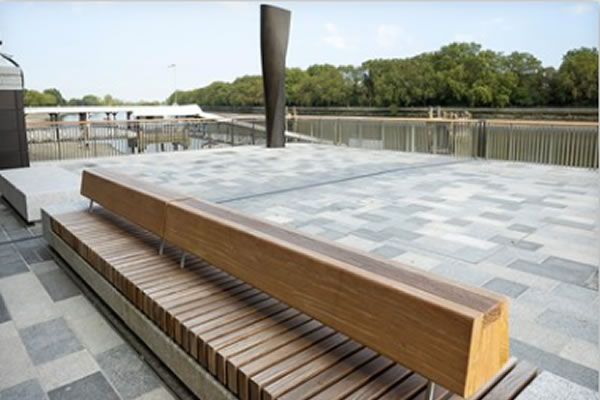
The connection between the new tunnel and the Victorian system at Putney Embankment is under an new riverside public space. Picture: Tideway
February 17, 2025
Tideway, the company which has built the ‘super sewer’ under the River Thames, has announced the full activation of the system.
Connections are now complete at a all locations including at Putney Embankment. This was among the last of 21 connections between the original Victorian sewers and the new 25km Thames Tideway Tunnel.
The link between the super sewer and the Hammersmith Pumping Station was completed earlier.
The system will continue to be operated by the contractors to allow for testing in storm conditions before being handed over to Thames Water later this year.
Historically, the sewer network has struggled to cope with the twin challenges of population growth and climate change, with rainfall regularly overwhelming the system and causing it to discharge into the Thames.
The work of bringing the full system online began in the autumn of 2024, when Tideway announced that the first four connections had led to 589,000 tonnes of storm sewage being captured by t in a single, rainy 24-hour period. Now, with the super sewer fully connected, Tideway says 95 per cent of those spills are being stopped. It has published its latest data on sewage prevented from entering the river since it first started connecting the super sewer. 5,500,000m³ has been captured to date – the equivalent of 2,200 Olympic-sized swimming pools.
Tideway CEO Andy Mitchell said, “This is another significant step forward – with this final connection complete, the super sewer is fully up and running and protecting the Thames. Our next step is to test it in storm conditions – which is why we are keeping a close eye on the weather – and we will do this over the coming months.
“We are at the start of a new chapter for London and its river. Our mission has always been about creating not just a tunnel, but a healthier, thriving environment for the river and its inhabitants. We look forward to seeing a real impact in the years to come and sharing everything we learn about the positive changes.”
The 25km-long super sewer connects to the 6.9km-long existing Lee Tunnel, a Thames Water asset – forming the ‘London Tideway Tunnel’ (LTT) system.
More than 20 deep shafts – some as wide as the dome of St Paul’s Cathedral – were constructed across London to divert sewage flows and to lower tunnelling machines into the ground.
The first of these giant machines started work deep beneath London in 2018, with primary tunnelling on the 25km main tunnel and two smaller connection tunnels completed in 2022.
By the autumn of 2023, a secondary tunnel lining was fully complete on all the tunnels, with the heavy civil engineering work then completed in the spring of 2024.
The Tideway project is being delivered by an alliance of contractors. The west region is being delivered by a joint venture of BAM Nuttall, Morgan Sindall Infrastructure and Balfour Beatty. The central region is being delivered by a joint venture of Ferrovial Agroman UK and Laing O'Rourke. The east region is being delivered by a joint venture of Costain, Vinci Construction Grands Projets and Bachy Soletanche.
System integration is being delivered by Amey, which is responsible for providing process control, communication equipment and software systems for operation, maintenance and reporting across the Thames Tideway Tunnel system.
The project is on track to be fully complete (with testing complete) later this year. Thames Water will then operate the system, as part of its London wastewater network.
Steve Reed, Environment Secretary said, “This Government is determined to clean up our polluted rivers, lakes and seas – and that includes the capital’s iconic Thames river.
“The Thames Tideway Tunnel is an example of the kind of infrastructure investment needed to clean up our waterways around the country and builds on this government’s wider ambition to boost national infrastructure under the Plan for Change.
“Just 70 days after the election, we introduced the Water (Special Measures) Bill to ban bonuses for failing firms and hold bosses criminally liable. We’ve also launched the largest water sector review since privatisation to boost investability into the sector and speed up the building of infrastructure.”
Mayor of London, Sadiq Khan added, “This is an important milestone, which will mean a huge reduction in sewage going into the tidal Thames. We must now build on this work to go further and tackle the other sources of pollution damaging London’s waterways. I’m determined to make our rivers cleaner, safer and more accessible so that Londoners can enjoy the benefits of nature as we continue to build a greener and better city for all.”
Like Reading Articles Like This? Help Us Produce More This site remains committed to providing local community news and public interest journalism. Articles such as the one above are integral to what we do. We aim to feature as much as possible on local societies, charities based in the area, fundraising efforts by residents, community-based initiatives and even helping people find missing pets. We’ve always done that and won’t be changing, in fact we’d like to do more. However, the readership that these stories generates is often below that needed to cover the cost of producing them. Our financial resources are limited and the local media environment is intensely competitive so there is a constraint on what we can do. We are therefore asking our readers to consider offering financial support to these efforts. Any money given will help support community and public interest news and the expansion of our coverage in this area. A suggested monthly payment is £8 but we would be grateful for any amount for instance if you think this site offers the equivalent value of a subscription to a daily printed newspaper you may wish to consider £20 per month. If neither of these amounts is suitable for you then contact info@neighbournet.com and we can set up an alternative. All payments are made through a secure web site. One-off donations are also appreciated. Choose The Amount You Wish To Contribute. If you do support us in this way we’d be interested to hear what kind of articles you would like to see more of on the site – send your suggestions to the editor. For businesses we offer the chance to be a corporate sponsor of community content on the site. For £30 plus VAT per month you will be the designated sponsor of at least one article a month with your logo appearing if supplied. If there is a specific community group or initiative you’d like to support we can make sure your sponsorship is featured on related content for a one off payment of £50 plus VAT. All payments are made through a secure web site. |