Thames Tideway Tunnel Already Has Had an Impact
Captures 850,000 tonnes of sewage during recent heavy rainfall
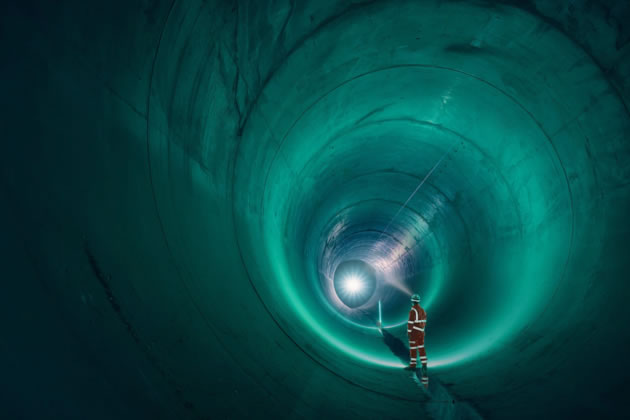
Some of the tunnel shafts are as wide as the dome of St. Paul's Cathedral. Picture: Matthew Joseph
December 10, 2024
Although it is not fully operational, the Thames Tideway Tunnell is already helping to reduce the amount of sewage being discharged into the river.
During heavy rainfall that took place on 27 November, nearly 850,000 tonnes of sewage was captured in one day on the network of tunnels which has 12 out of 21 sewer connection points live. At its peak, the entire system was over half full, containing nearly one million tonnes of storm sewage.
The new super sewer is designed to ‘intercept’ spill points in the river wall and improve the health of the River Thames.
In October, the company announced that the first of the 21 connection points had been activated and since then more have come on line including at Chelsea, Blackfriars and Westminster. Historically, London’s existing sewer network was overwhelmed during even light rainfall, with storm flows discharged directly into the Thames.
Roger Bailey, Tideway’s Chief Technical Officer, said, “These new figures show the super sewer starting to do its job. As more connections come online, the protection of the river will increase further, dramatically improving its health. There is still work to do but our teams are working hard to make the new infrastructure fully operational next year.”
Nevil Muncaster, Asset Management and Engineering Director, Thames Water, added, “During storms like we’ve just seen, the super sewer really come into its own; successfully protecting the environment from wastewater overflows that would otherwise have been necessary .
“The Thames Tideway Tunnel is a significant part of our overall investment programme, developed over many years, to improve the health of the Thames. Collectively these investments will culminate in a 95% reduction in storm overflows in the capital once it’s fully commissioned next year.”
Work on the project began in 2016 – with activity taking place at two dozen construction sites from Acton in west London to Abbey Mills Pumping Station in Stratford, east London. More than 20 deep shafts – some as wide as the dome of St Paul’s Cathedral – were constructed across London to divert sewage flows and to lower tunnelling machines into the ground.
The project is due to be fully up and running (with testing complete) in 2025. Thames Water will then operate the system, as part of its London wastewater network.
Like Reading Articles Like This? Help Us Produce More This site remains committed to providing local community news and public interest journalism. Articles such as the one above are integral to what we do. We aim to feature as much as possible on local societies, charities based in the area, fundraising efforts by residents, community-based initiatives and even helping people find missing pets. We’ve always done that and won’t be changing, in fact we’d like to do more. However, the readership that these stories generates is often below that needed to cover the cost of producing them. Our financial resources are limited and the local media environment is intensely competitive so there is a constraint on what we can do. We are therefore asking our readers to consider offering financial support to these efforts. Any money given will help support community and public interest news and the expansion of our coverage in this area. A suggested monthly payment is £8 but we would be grateful for any amount for instance if you think this site offers the equivalent value of a subscription to a daily printed newspaper you may wish to consider £20 per month. If neither of these amounts is suitable for you then contact info@neighbournet.com and we can set up an alternative. All payments are made through a secure web site. One-off donations are also appreciated. Choose The Amount You Wish To Contribute. If you do support us in this way we’d be interested to hear what kind of articles you would like to see more of on the site – send your suggestions to the editor. For businesses we offer the chance to be a corporate sponsor of community content on the site. For £30 plus VAT per month you will be the designated sponsor of at least one article a month with your logo appearing if supplied. If there is a specific community group or initiative you’d like to support we can make sure your sponsorship is featured on related content for a one off payment of £50 plus VAT. All payments are made through a secure web site. |