Thames Found to Be Toxic Ahead of Boat Race
Measurements along the route show high levels of E.coli
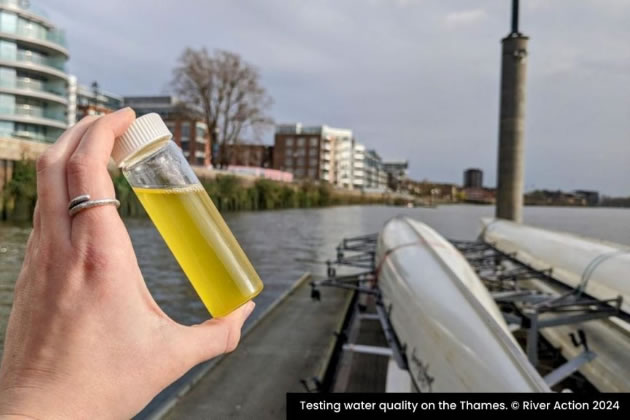
Samples were taken at Fulham Reach near Hammersmith Bridge
March 27, 2024
An environmental action group has released data on measurements it has taken of the impact of sewage being pumped into the Thames ahead of the University Boat Races.
Between 28 February and 26 March, River Action conducted 16 tests on the River Thames near Fulham Reach Boat Club around Hammersmith Bridge which the crews will pass as they row between Putney and Chiswick. These indicated an average of 2,863 E.coli bacteria colony forming units (CFU) per 100ml of water. To meet bathing water quality standards, this level should be below 1,000 CFU per 100ml. The highest recorded measurement reached 9,801 CFU, nearly ten times the acceptable limit.
By comparison, the Environment Agency conducts between 3 and 20 water quality tests of bathing water sites between May and September to decide the status. According to the Environment Agency, an inland water registering 1,000 CFU or greater is unsafe to swim.
Heavy rain overnight on 27 March, after these tests were taken, has meant that sewage has been continually pumped from a number of Thames Water sites including the Acton and Storm Works which had outflow for six hours until just after 3am. The Jews Row Pumping Station (Falconbrook Storm Relief) was still having outflow at 9am on Wednesday morning after pumping out sewage into the river for over six hours.
According to publicly available data, by 26 March Thames Water had discharged sewage into the Greater London area of the River Thames for 1,914 hours since the start of 2024, equivalent to 79 days. The data comes from 40 storm overflow sites between Kingston and the mouth of the river in the east.
British Rowing, River Action and The Rivers Trust have developed a set of guidelines for rowing on poor quality water. ‘Guidance on rowing when water quality is poor’ has been written to minimise the risk of contracting illness due to proximity to polluted water.
Included are tips on the importance of covering cuts, grazes, and blisters with waterproof dressings, taking care not to swallow river water that splashes close to the mouth, wearing suitable footwear when launching or recovering a boat, and cleaning all equipment thoroughly.
The new guidance has been issued to rowing clubs across the country. The upcoming Boat Race has included the guidance in their briefing packs to both universities and issued further advice to ensure the athletes are as safe as possible.
CEO of River Action James Wallace said, “We are in a tragic situation when elite athletes are issued with health guidance ahead of a historic race on the capital’s river. Our water quality results show what happens after decades of neglect by an unregulated water company, Thames Water. However, thanks to the vigilance of competition organisers, supported by British Rowing, River Action and The Rivers Trust, we are pleased they are showing their duty of care to the competing teams this weekend, and working with us to address the source of the problem: ending river pollution.
“For the safety of river users everywhere, rowers, communities and conservationists are uniting to ask the Government to enforce the law and to prosecute polluters. River Action wants water companies to honour their commitments to the regulators and bill payers by investing in their infrastructure and stop dumping sewage. Everyone should be able to enjoy our rivers and seas without risking their health.”
Imogen Grant, triple Boat Race winner with Cambridge, double World and European champion rower said, “As a rower, the water I row on is my field of play, and the results of the E.coli testing show that rowers are putting their health at risk to do the sport they love. Thousands of people rely on our rivers for work and recreation, and they are being choked with sewage and pollution. More needs to be done to improve our water quality across the country, and testing like this gives us a picture of just how far we have to go.”
Responding to the results of water quality testing on the River Thames, CEO of Fulham Reach Boat Club Adam Freeman-Pask said, “High levels of E.coli match the trend of organic pollution found through our citizen science water quality testing. This data must serve as a wake-up call for policymakers, regulators, and water companies. The river is a lifeline for Londoners’ health and wellbeing, which we need to protect. We welcome the new guidance to help us enjoy the river safely.”
CEO of British Rowing Alastair Marks said, “As rowers, we spend the majority of our time on and around the water, so water quality is a particularly key issue to us. Over 30 rowing clubs sit along the Boat Race course, with thousands of rowers taking to the Thames every day. Our recently launched Environmental Sustainability Strategy outlines the steps rowers can take to row safely, so we can keep rowing and keep inspiring a love and care for our waters in our community. We’re impressed at how quickly our clubs and members have got behind our newly issued guidance, and how competitions are using it to keep their competitors safe.”
River champion and naturalist Steve Backshall MBE said, “I am appalled but unsurprised by the high levels of E.coli detected by River Action in the stretch of the Thames where the university rowers will compete.
“Recently we heard from Thames Water how they will not contribute to a £180m industry-wide scheme to fast-track efforts to reduce pollution in England’s waterways. But they do want to increase customer bills and increase dividends to shareholders as well as position to get a massive taxpayer bailout to clear debts including a £190m loan due in April. From where I am standing, Thames Water is one flush from disappearing down its broken sewage pipe.”
The Thames Tideway tunnel will significantly reduce the amount of sewage overflow ending up in the Thames. This is currently expected to be operational next year.
A Thames Water spokesperson said, “Taking action to improve the health of rivers is a key focus for us and we want to lead the way with our transparent approach to data. We remain the only company to provide live alerts for all untreated discharges and this ‘near real-time’ data is available to customers as a map on our website and is also available through an open data platform for third parties, such as swimming and environmental groups to use.
"We have experienced higher than average long-term rainfall across London and the Thames Valley with groundwater levels exceptionally high for the time of the year. The overflows are designed to operate automatically when the sewer network is about to be overwhelmed which then releases diluted wastewater into rivers, rather than letting it back up into people’s homes. We are working hard to make these discharges unnecessary and have published plans to upgrade over 250 of our sites, including a £100 million upgrade of our Mogden sewage treatment works in South West London to treat the high volumes of incoming sewage and reduce the need for overflows during wet weather.”
Like Reading Articles Like This? Help Us Produce More This site remains committed to providing local community news and public interest journalism. Articles such as the one above are integral to what we do. We aim to feature as much as possible on local societies, charities based in the area, fundraising efforts by residents, community-based initiatives and even helping people find missing pets. We’ve always done that and won’t be changing, in fact we’d like to do more. However, the readership that these stories generates is often below that needed to cover the cost of producing them. Our financial resources are limited and the local media environment is intensely competitive so there is a constraint on what we can do. We are therefore asking our readers to consider offering financial support to these efforts. Any money given will help support community and public interest news and the expansion of our coverage in this area. A suggested monthly payment is £8 but we would be grateful for any amount for instance if you think this site offers the equivalent value of a subscription to a daily printed newspaper you may wish to consider £20 per month. If neither of these amounts is suitable for you then contact info@neighbournet.com and we can set up an alternative. All payments are made through a secure web site. One-off donations are also appreciated. Choose The Amount You Wish To Contribute. If you do support us in this way we’d be interested to hear what kind of articles you would like to see more of on the site – send your suggestions to the editor. For businesses we offer the chance to be a corporate sponsor of community content on the site. For £30 plus VAT per month you will be the designated sponsor of at least one article a month with your logo appearing if supplied. If there is a specific community group or initiative you’d like to support we can make sure your sponsorship is featured on related content for a one off payment of £50 plus VAT. All payments are made through a secure web site. |