Green Light for Massive Data Centre Near Heathrow
Councillors approve plan despite concerns about use of water and energy
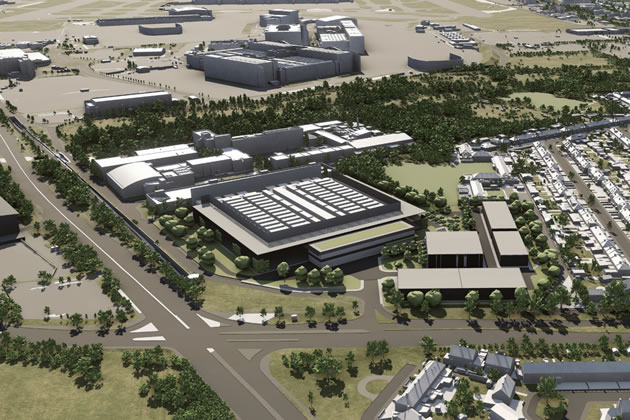
A visualisation of the proposed data centre from planning document
August 11, 2026
Another data centre is on the way to West London after Hounslow Council gave the green light to proposals despite the increased demand on water and energy supplies.
Hounslow Council’s Planning Committee voted in favour of the plans on Thursday, 6 August. The data centre will be located on a 12.2 acre brownfield site at the interchange of Great South-West Road and The Parkway in the Haslemere Heathrow Estate.
Additionally, the scheme secures up to 4,150 square metres of flexible work units designed for small-to-medium enterprises (SMEs) to mitigate the loss of traditional employment space. Despite the approval, there was friction during the hearing about the electrical demand of the facility which requires a new 80MVA (Megavolt-Amperes) high-capacity power connection – equivalent to tens of thousands of homes.
Green Party Councillor, Guy Lambert, voiced concerns about the regional capacity shortage in West London. He asked, “Are we convinced that there’s electricity availability because we know there is a shortage of electricity availability in West London and this thing will take up enough power to – my friend who knows about these things says it’s the same as 550,000 houses.”
A council planning officer sought to reassure the committee, clarifying that the developer’s utility agreements ensure the energy will be imported directly from the National Energy System Operator via the Laleham Grid Supply Point. As this is routed entirely from outside Hounslow’s boundaries, officers confirmed it would not drain existing electrical capacity earmarked for other borough developments, such as new housing.
However, there was no information on how it will affect local water supplies, given the known water consumption of data centres for cooling their servers, despite the fact London is currently experiencing an official drought.
In May, Affinity Water, which supplies parts of the borough of Hounslow, told MPs that some data centres were requesting up to 3 million litres of water a day, equivalent to the peak water demand of 3,500 homes.
Cllr Lambert was also sceptical about the job creation projections. Council documents indicate that 210 operational jobs (90 within the data centre and 120 in the SME units) will be created. However, this represents a net gain of just two jobs, with 10 active businesses and 208 existing workers set to be displaced from the estate by 2027.
He said, “They’ve cooked up something which mysteriously comes up with 210 jobs as a result of this development… I’m very sceptical that this will provide 210 jobs or more than about 10 jobs actually.”
The Greater London Authority’s (GLA) initial Stage 1 report had previously warned that the scheme did not fully comply with the London Plan, citing concerns over transport, and high water and energy intensity.
Under the approved terms, the developer must submit a strategy to minimise operational water consumption. Environmental groups also expressed concern over potential noise disruptions to local wildlife along the adjacent River Crane corridor.
To address this, the committee imposed strict mechanical noise limits which includes cumulative rating levels from the data centre’s cooling plant. To offset the footprint of the development, the council also secured environmental and infrastructure contributions through the Section 106 Agreement.
This includes £100,000 allocated to TfL for a cycling and pedestrian safety feasibility study at the junction of The Parkway (A312) and Great South-West Road (A30) following a history of collisions. There will also be a contribution of £2,750 for every £1 million of construction costs paid to Hounslow Council to train local residents in technology and engineering.
Additionally, the agreement secures affordable workspace for SMEs at a rental discount of 45% below market rate, subject to final viability testing.
Out of 450 neighbours formally notified of the proposals by post, and four site notices posted on nearby streets, only one formal resident objection was received. The objection focused on power capacity and noise from cooling units. Cranford Primary School, located nearby, wrote a letter of support, welcoming the developer’s initiatives to improve local safety, pedestrian crossings, and green space near the school.
All councillors present voted in favour of the plans apart from Cllr Lambert, who voted against. The plans will now go before the Mayor of London for Stage 2 approval.
Philip James Lynch - Local Democracy Reporter
Like Reading Articles Like This? Help Us Produce More This site remains committed to providing local community news and public interest journalism. Articles such as the one above are integral to what we do. We aim to feature as much as possible on local societies, charities based in the area, fundraising efforts by residents, community-based initiatives and even helping people find missing pets. We’ve always done that and won’t be changing, in fact we’d like to do more. However, the readership that these stories generates is often below that needed to cover the cost of producing them. Our financial resources are limited and the local media environment is intensely competitive so there is a constraint on what we can do. We are therefore asking our readers to consider offering financial support to these efforts. Any money given will help support community and public interest news and the expansion of our coverage in this area. A suggested monthly payment is £8 but we would be grateful for any amount for instance if you think this site offers the equivalent value of a subscription to a daily printed newspaper you may wish to consider £20 per month. If neither of these amounts is suitable for you then contact info@neighbournet.com and we can set up an alternative. All payments are made through a secure web site. One-off donations are also appreciated. Choose The Amount You Wish To Contribute. If you do support us in this way we’d be interested to hear what kind of articles you would like to see more of on the site – send your suggestions to the editor. For businesses we offer the chance to be a corporate sponsor of community content on the site. For £30 plus VAT per month you will be the designated sponsor of at least one article a month with your logo appearing if supplied. If there is a specific community group or initiative you’d like to support we can make sure your sponsorship is featured on related content for a one off payment of £50 plus VAT. All payments are made through a secure web site. |