Virtual Reality Transforms Training at Park Royal Hospital
Surgeons at St Mark's National Bowel Hospital learning with immersive tech
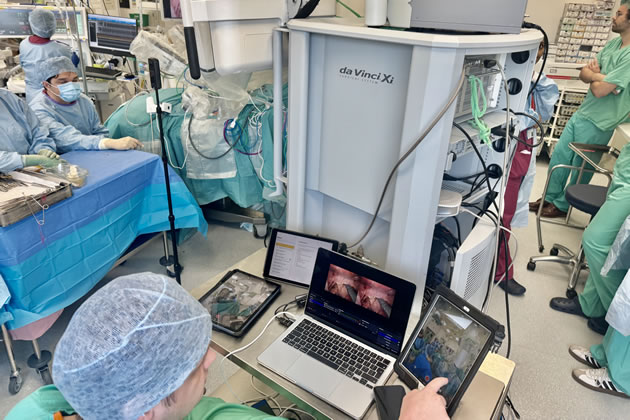
The training module was developed in partnership with tech company Revolve Labs
February 23, 2026
Trainee surgeons at St Mark’s National Bowel Hospital are getting a new way to learn complex operations outside the operating theatre thanks to an immersive virtual reality training module developed in partnership with tech company Revolve Labs.
The project began when consultant colorectal surgeon Kapil Sahnan invited Revolve Labs to film a robotic pan-proctocolectomy, a demanding five-and-a-half-hour procedure that removes the entire intestinal system before rerouting the small intestine to an external pouch. Revolve Labs recorded the operation using multiple 360-degree cameras, GoPros mounted on surgeons’ heads and stereoscopic outputs from the Da Vinci robotic console, capturing more than 16 hours of footage that blends wide-theatre perspectives with the surgeon’s own three-dimensional view.
The resulting training module recreates the operation in 3D and allows users wearing VR headsets to switch between viewpoints, access supplementary information and revisit key stages of the procedure on demand. The immersive format is designed to give trainees repeated exposure to critical steps that would otherwise be difficult to observe in full during live surgery.
Gita Lingam, a surgical trainee at St Mark’s, described the technology as “a huge step forward in surgical training.” She said the ability to watch 3D surgical footage outside the operating theatre and to replay important moments “as many times as needed” could significantly enhance learning. “A huge part of surgical training is observing numerous procedures,” Lingam added, “and these VR simulation modules will make it easier to do so. The hope is that this technology would enhance our ability to perform real-life procedures and thus improve patient outcomes.”
Developers say the module is the first in what they hope will be a series of immersive experiences that transform how surgery is taught. By combining the surgeon’s console view with theatre-level perspectives, the VR package aims to bridge the gap between observation and hands-on practice, offering trainees a richer understanding of team dynamics, instrument handling and the sequence of complex manoeuvres.
Beyond immediate training benefits, proponents argue that such simulations could reduce pressure on operating lists by allowing trainees to prepare more thoroughly in advance, and could standardise exposure to rare or lengthy procedures that are difficult to schedule for observation. The St Mark’s initiative also highlights how advances in recording technology and virtual reality can be harnessed to preserve and share surgical expertise across institutions.
The hospital and Revolve Labs plan to evaluate the module’s impact on trainee competence and confidence, and to develop further VR resources that cover other complex procedures. If successful, the approach could become a model for surgical education, offering a scalable way to supplement theatre experience with high-fidelity, repeatable learning outside the operating room.
Like Reading Articles Like This? Help Us Produce More This site remains committed to providing local community news and public interest journalism. Articles such as the one above are integral to what we do. We aim to feature as much as possible on local societies, charities based in the area, fundraising efforts by residents, community-based initiatives and even helping people find missing pets. We've always done that and won't be changing, in fact we'd like to do more. However, the readership that these stories generates is often below that needed to cover the cost of producing them. Our financial resources are limited and the local media environment is intensely competitive so there is a constraint on what we can do. We are therefore asking our readers to consider offering financial support to these efforts. Any money given will help support community and public interest news and the expansion of our coverage in this area. A suggested monthly payment is £8 but we would be grateful for any amount for instance if you think this site offers the equivalent value of a subscription to a daily printed newspaper you may wish to consider £20 per month. If neither of these amounts is suitable for you then contact info@neighbournet.com and we can set up an alternative. All payments are made through a secure web site. One-off donations are also appreciated. Choose The Amount You Wish To Contribute. If you do support us in this way we'd be interested to hear what kind of articles you would like to see more of on the site – send your suggestions to the editor. For businesses we offer the chance to be a corporate sponsor of community content on the site. For £30 plus VAT per month you will be the designated sponsor of at least one article a month with your logo appearing if supplied. If there is a specific community group or initiative you'd like to support we can make sure your sponsorship is featured on related content for a one off payment of £50 plus VAT. All payments are made through a secure web site. |