Park Royal Surgeon Wears Exoskeleton During Operation
Becomes first to use new technology designed to reduce strain
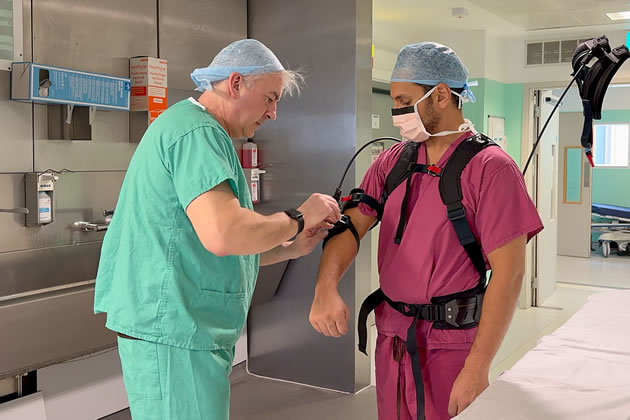
Mr Kapil Sahnan having the device fitted
February 5, 2026
A surgeon at a hospital in Park Royal has become the first to carry out an operation while wearing an exoskeleton designed to reduce physical strain during long procedures.
Mr Kapil Sahnan, a colorectal surgeon at St Mark’s National Bowel Hospital, used the device during a seven-hour operation on a patient with inflammatory bowel disease. The lightweight suit, worn over surgical scrubs, is intended to support the arms, shoulders and upper body, helping surgeons maintain posture and reduce fatigue.
Mr Sahnan said long operations can take a physical toll. “Surgery can be physically very demanding, especially during longer procedures, which can last many hours,” he said. “Being hunched over an operating table is not great for your posture, so this is a welcome piece of kit for surgeons.”
Before the operation, specialists from Stanley, the company supplying the equipment, assessed his movement using an app designed to analyse posture and strain. They recommended the Hapo Front exoskeleton, which uses adjustable straps across the back, shoulders and arms to support the musculoskeletal system while allowing full freedom of movement.
Mr Sahnan said the device did not interfere with the precision required in surgery. “It’s very good because you can maintain the dexterity of your hands while performing surgery,” he said. “It is surprisingly easy to put on and adjust, and it is certainly something I will be using again. We’re a specialised hospital with a small niche workforce, so we can't afford to have surgeons going off sick with issues like muscular disorders, which is a common side effect of the profession.”
The operation involved removing an ileoanal pouch for a patient who had undergone multiple previous surgeries.
Mr Sahnan, recently appointed Director of Innovation at St Mark’s, said the hospital intends to continue exploring new technologies that support both staff and patients. “We are a small hospital with a long history of innovation regarding bowel disease, so we should pay tribute to our predecessors by continuing to push forward,” he said.
Graham Sharp, managing director of Stanley, said the trial showed how wearable technology could support clinical teams. “The fantastic feedback from Mr Sahnan and his team demonstrates how exoskeleton technology is supporting the profession, particularly during lengthy operations,” he said. He added that AI-powered wearable devices are increasingly being adopted across healthcare and could become standard equipment in operating theatres in the future.
Like Reading Articles Like This? Help Us Produce More This site remains committed to providing local community news and public interest journalism. Articles such as the one above are integral to what we do. We aim to feature as much as possible on local societies, charities based in the area, fundraising efforts by residents, community-based initiatives and even helping people find missing pets. We've always done that and won't be changing, in fact we'd like to do more. However, the readership that these stories generates is often below that needed to cover the cost of producing them. Our financial resources are limited and the local media environment is intensely competitive so there is a constraint on what we can do. We are therefore asking our readers to consider offering financial support to these efforts. Any money given will help support community and public interest news and the expansion of our coverage in this area. A suggested monthly payment is £8 but we would be grateful for any amount for instance if you think this site offers the equivalent value of a subscription to a daily printed newspaper you may wish to consider £20 per month. If neither of these amounts is suitable for you then contact info@neighbournet.com and we can set up an alternative. All payments are made through a secure web site. One-off donations are also appreciated. Choose The Amount You Wish To Contribute. If you do support us in this way we'd be interested to hear what kind of articles you would like to see more of on the site – send your suggestions to the editor. For businesses we offer the chance to be a corporate sponsor of community content on the site. For £30 plus VAT per month you will be the designated sponsor of at least one article a month with your logo appearing if supplied. If there is a specific community group or initiative you'd like to support we can make sure your sponsorship is featured on related content for a one off payment of £50 plus VAT. All payments are made through a secure web site. |