Initiative Aims to Improve Local Emergency Care for Veterans
Project being led by James Spink who was wounded in Afghanistan
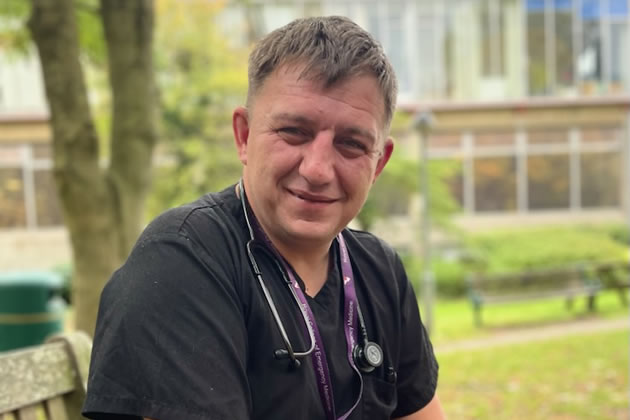
James Spink. Picture: LNWH
November 12, 2025
James Spink, a 37-year-old combat veteran and advanced care practitioner in the A&E at London North West University Healthcare NHS Trust (LNWH), is planning a quality improvement project to help emergency departments better identify, treat and support veterans. The project, which forms part of his master’s degree, would establish a dedicated clinic within A&E to give veterans focused assessment and follow-up, he said, because “there are a lot of us out there.”
James hopes the clinic will create a safer, more informed route for veterans who present in crisis or with complex health needs related to service. “I want other veterans to get the same sort of support,” he said. “Everyone has been very supportive. I feel like I can do anything when I put on my uniform.”
James’s own route into medicine and emergency care began after he joined the Army as a troubled teenager seeking discipline and structure. He served on peacekeeping duty in Kosovo at 18 and later completed two tours of Afghanistan, where his roles included guarding infrastructure and working as a combat medic checking for improvised explosive devices. It was on his second tour that an IED exploded beneath his vehicle and fractured his spine.
He says, “I vaguely remember an American giving me pain relief saying I’d be OK and seeing pink elephants soon. The bloody things haunted my dreams after that.
“The next thing I remember was waking up in a military hospital in England being told I was paralysed from the waist down. It wasn’t a good time.”
It was the start of a long painful recovery that included 17 months of rehabilitation that eventually led to James’s learning to walk again with the aid of a computerised leg brace.
“The turning point for me was seeing lads in a far worse condition than me just cracking on with it and making the best of it,” James recalled. “The leg brace was a real gamechanger.” His subsequent NHS career has included work as a paramedic, service on a Medivac team bringing critically ill patients back to the UK, and time in a rehabilitation unit at the hospital where he was treated. He joined LNWH two years ago and now treats emergency patients as an advanced care practitioner.
LNWH runs emergency services at Northwick Park, Ealing and Central Middlesex hospitals, providing 24/7 consultant-led A&E care with majors and minors areas, supported by urgent treatment and observation facilities, diagnostics and multidisciplinary teams. James believes a dedicated veterans pathway within such A&E services could help flag patients whose symptoms are linked to military service, reduce missed diagnoses, and provide a clearer route to community and specialist support.
His mothering responsibilities and life outside work have also shaped his outlook. James is a father of four and credits family and partners with sustaining him through difficult times. He said he still has “bad days” but tries to focus on progress and resilience. Remembrance Sunday brings mixed emotions; he recently wore his Army uniform publicly for the first time in years when his father died.
The proposed veterans’ clinic will be developed alongside James’s academic supervisors and hospital colleagues, with the aim of piloting a model that other emergency departments could replicate. If successful, the initiative could formalise how frontline clinicians ask about military history, link patients to dedicated veteran support charities and specialist mental and physical health services, and ensure follow-up after discharge.
James describes his motivation simply, “Everything takes time. You just have to be patient with yourself and not give up. That’s the message I want to share with people.”
Like Reading Articles Like This? Help Us Produce More This site remains committed to providing local community news and public interest journalism. Articles such as the one above are integral to what we do. We aim to feature as much as possible on local societies, charities based in the area, fundraising efforts by residents, community-based initiatives and even helping people find missing pets. We've always done that and won't be changing, in fact we'd like to do more. However, the readership that these stories generates is often below that needed to cover the cost of producing them. Our financial resources are limited and the local media environment is intensely competitive so there is a constraint on what we can do. We are therefore asking our readers to consider offering financial support to these efforts. Any money given will help support community and public interest news and the expansion of our coverage in this area. A suggested monthly payment is £8 but we would be grateful for any amount for instance if you think this site offers the equivalent value of a subscription to a daily printed newspaper you may wish to consider £20 per month. If neither of these amounts is suitable for you then contact info@neighbournet.com and we can set up an alternative. All payments are made through a secure web site. One-off donations are also appreciated. Choose The Amount You Wish To Contribute. If you do support us in this way we'd be interested to hear what kind of articles you would like to see more of on the site – send your suggestions to the editor. For businesses we offer the chance to be a corporate sponsor of community content on the site. For £30 plus VAT per month you will be the designated sponsor of at least one article a month with your logo appearing if supplied. If there is a specific community group or initiative you'd like to support we can make sure your sponsorship is featured on related content for a one off payment of £50 plus VAT. All payments are made through a secure web site. |