Acceptance of Revised Gunnersbury Park Plan Recommended
Committee set to reconvene to consider five-year events permission
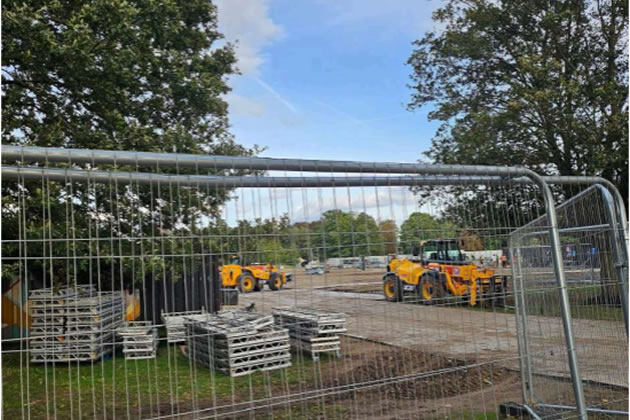 The new proposal leaves the number of days parts of the park are fenced off unchanged. Picture: GPGERA
August 26, 2026
Hounslow Council’s Planning Committee is due to reconsider whether Gunnersbury Park should host up to 19 large-scale commercial events a year for the next five years. A report by borough planning officers recommending approval of a revised scheme has been published, but some residents say the process has become so skewed against them that public trust is “reaching breaking point”.
The application, submitted by Gunnersbury Park & Museum CIC, was deferred earlier this month after councillors asked the organisation to reduce the number of event days. The CIC has now returned with a revised proposal: 19 live event days per year, down from 22, with 115 days of occupation including set-up, removal and trackway installation. The number of the largest “Band 1” events — those attracting between 20,000 and 29,999 people — has been cut from ten to nine. “Band 2” events, capped at 19,999 attendees, have been reduced from twelve to ten.
The borough planning team argues the changes strike an acceptable balance between public access, heritage protection and the park’s financial needs. The report states that the temporary structures and closures “would not result in long-term harm” to the Grade II* listed landscape, and that noise impacts would be mitigated through monitoring and reduced bass limits. They also emphasise the CIC’s financial position: the organisation now relies on commercial revenue for over 66% of its budget, with live events, retail, parking, weddings and rentals generating around £950,000 in 2025. The CIC states that council funding now accounts for only 20% of its income and is due to fall.
But the Gunnersbury Park Garden Estate Residents’ Association (GPGERA) says the revised proposal does nothing to address the deeper concerns about how the process has been handled. It describes “consultation by exhaustion”, citing four rounds of consultation, late letters, restricted speaking rights, and almost 500 previously submitted objections being disregarded. Letters dated 12 August, they note, did not arrive until 18 August, leaving residents “almost a week” short of the statutory consultation period.
The group states, “Residents say trust in Hounslow Council’s planning process is reaching breaking point.”
The association argues that the pattern is now unmistakable: “the applicant gets another revision, residents get another deadline.”
Beyond procedure, residents continue to challenge the core justification for the events. They point to the Rothschild Restrictive Covenant, which limits the park’s use to public recreation and sports, and question how a five-year programme of commercial festivals — with ticketing, fencing, trackway and private hire — can be compatible with that restriction. They also call for full financial transparency, urging the CIC and councils to “open the books” and publish detailed accounts, contractor payments, staffing costs and event income.
GPGERA also notes that despite millions in public funding and commercial revenue, several historic buildings remain derelict, including Potomac Tower, which is within the CIC’s lease. It also highlights discrepancies in the CIC’s own statements about heritage costs — from a claimed £30 million deficit in 2025 to £1.8 million in cyclical repairs cited in 2026.
Noise remains another flashpoint. Residents have repeatedly asked for Gunnersbury’s limits to match Hyde Park’s 65 dB(A) threshold. GPGERA quotes the Westminster licence directly: “music noise must not exceed 15 dB above background noise or 65 dB LAeq,5 minute, whichever is lower.” Yet Gunnersbury’s proposed limits remain significantly higher, at 73 dB(A) and 88 dB(C) for bass.
The August committee meeting showed how sharply views diverge. Councillors Ron Mushiso and Joanna Biddolph spoke against the application, citing years of complaints about noise, crime, access restrictions and disruption. Councillors Lambert and Bowring supported the full 22-day proposal, arguing that major events provide essential income for park improvements. The committee ultimately voted to defer the decision, with 11 votes in favour.
Now councillors must decide whether the revised 19-day plan is enough to satisfy concerns — or whether the process itself has become too compromised to command public confidence.
GPGERA is urging councillors to restore lost consultation time, carry forward previous objections, allow public speaking at the meeting, address outstanding complaints, and resolve the covenant issue before any vote. Above all, they say, councillors must ensure that “public land, public money and a five-year planning decision require public accountability.”
The Planning Committee is expected to make its decision at the meeting scheduled for 3 September. Observers noted that during the last meeting, Labour councillors on the committee appear not to have been whipped to support the proposal and it is believed by some that this time they may be required to vote in favour.
Like Reading Articles Like This? Help Us Produce More This site remains committed to providing local community news and public interest journalism. Articles such as the one above are integral to what we do. We aim to feature as much as possible on local societies, charities based in the area, fundraising efforts by residents, community-based initiatives and even helping people find missing pets. We’ve always done that and won’t be changing, in fact we’d like to do more. However, the readership that these stories generates is often below that needed to cover the cost of producing them. Our financial resources are limited and the local media environment is intensely competitive so there is a constraint on what we can do. We are therefore asking our readers to consider offering financial support to these efforts. Any money given will help support community and public interest news and the expansion of our coverage in this area. A suggested monthly payment is £8 but we would be grateful for any amount for instance if you think this site offers the equivalent value of a subscription to a daily printed newspaper you may wish to consider £20 per month. If neither of these amounts is suitable for you then contact info@neighbournet.com and we can set up an alternative. All payments are made through a secure web site. One-off donations are also appreciated. Choose The Amount You Wish To Contribute. If you do support us in this way we’d be interested to hear what kind of articles you would like to see more of on the site – send your suggestions to the editor. For businesses we offer the chance to be a corporate sponsor of community content on the site. For £30 plus VAT per month you will be the designated sponsor of at least one article a month with your logo appearing if supplied. If there is a specific community group or initiative you’d like to support we can make sure your sponsorship is featured on related content for a one off payment of £50 plus VAT. All payments are made through a secure web site. |