Gunnersbury Park CIC Submits Rapidly Revised Proposal
Says nineteen events is minimum to make park sustainable
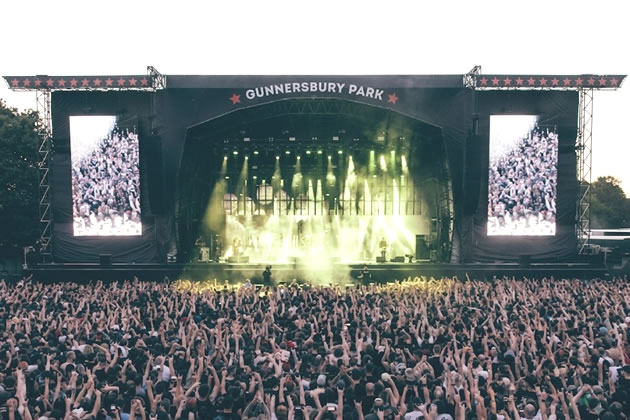 Band One events could still attract close to 30,000 people. Picture: Facebook
August 13, 2026
Gunnersbury Park & Museum CIC has submitted a significantly revised planning proposal for large-scale events at Gunnersbury Park, just days after Hounslow Council’s Planning Committee voted to defer its decision and requested reductions to the scale of the scheme. The updated submission, lodged under the existing reference P/2025/3274, will return to committee on 3 September, marking an unusually swift turnaround for a major application that has drawn intense public scrutiny.
The revised plans follow the closely watched committee meeting earlier this month, where councillors spent more than three hours debating whether the park should host up to 22 commercial event days per year until 2031. The original proposal—already reduced from a ten-year term to five—would have allowed concerts, festivals and other large-scale events to occupy parts of the Grade II* listed park for up to 115 days each year, including set-up and dismantling periods.
Planning officers acknowledged that the scheme would cause temporary harm to heritage assets and ecological sensitivities, but argued that the cultural and financial benefits outweighed the impacts when combined with mitigation measures. These included alternating event arenas, reduced noise limits, and strict licensing controls. Residents, however, raised concerns about cumulative noise, late-night disturbance, traffic congestion, fencing, loss of access, ecological harm and the long-term commercialisation of public green space. Councillors reported receiving dozens of emails ahead of the meeting.
Speakers from local groups—including Marie Rabouhans of the West Chiswick and Gunnersbury Society and Peter Bainbridge of the Gunnersbury Park Gardens Estate Residents’ Association—called for reductions or outright refusal. Chiswick Gunnersbury councillors Ron Mushiso and Joanna Biddolph also opposed the application, with Cllr Biddolph describing it as “the single most complained about topic in my inbox” since 2018.
Much of the committee’s debate centred on whether the number of permitted event days should be reduced. Several councillors expressed support for lowering the total, and the CIC’s spokesperson indicated that 19 days was the minimum required to honour existing contractual discussions. Planning officers advised that any reduction would require deferral and resubmission. Councillor Louki’s motion to defer was carried with eleven votes in favour, two against and one abstention.
The CIC has now responded with a substantially altered scheme that incorporates the committee’s feedback. The new proposal reduces the number of live event days from 22 to 19, further tightens noise limits, and introduces additional controls on infrastructure and trackway installation.
Key changes include:
- 19 live event days per year, down from 22
- 9 Band 1 days (20,000–29,999 attendees, max 73dB(A))
- 10 Band 2 days (3,500–19,999 attendees, max 70dB(A))
- Trackway included within the 115-day total, addressing concerns that ground protection could extend beyond the permitted period
- Continued voluntary reductions in maximum sound levels
- A commitment to four fixed continuous monitoring points plus up to three additional locations per event
- Confirmation that only one event arena will operate at any time, with no overlapping live days
The CIC emphasises that the revised 19-day limit represents the minimum viable programme needed to sustain the park’s finances. According to the submission, events generated approximately £950,000 in 2025, forming around 38% of commercial revenue. With one council partner signalling that its service fee funding will cease from April 2028, the Trust argues that multi-year event income is essential to avoid jeopardising the park’s long-term management and museum services.
The documents also outline the CIC’s unsuccessful bids to Green Roots and the National Heritage Lottery Fund, noting that most charitable funders support projects rather than core running costs. The Trust says it cannot currently resource a full-scale fundraising programme without the stability provided by multi-year event income.
The revised submission acknowledges the concerns raised by councillors and residents, particularly around noise, access, and the duration of infrastructure on site. It argues that the new 19-day limit, combined with reduced noise levels and tighter controls on trackway, represents a “substantial further reduction in the duration and intensity of the proposals.”
The CIC also stresses that Gunnersbury Park competes with other London venues for touring artists, and that the ability to offer nine higher-capacity days is essential to securing reputable operators and headline acts. Without this, the Trust warns it may struggle to maintain financial stability or meet upcoming repair and maintenance obligations.
The accompanying Event Management Plan Summary—also updated in August 2026—details the oversight mechanisms that will govern each event, including the Safety Advisory Group, licensing conditions, crowd management plans, traffic controls, environmental policies and accessibility measures. The CIC argues that these frameworks provide robust protection for residents and the park’s heritage landscape.
The revised proposal will be consulted upon and brought back to Hounslow’s Planning Committee on 3 September . Councillors will then decide whether the reduced programme strikes an acceptable balance between financial necessity, cultural benefit and the protection of Gunnersbury Park’s historic environment.Like Reading Articles Like This? Help Us Produce More This site remains committed to providing local community news and public interest journalism. Articles such as the one above are integral to what we do. We aim to feature as much as possible on local societies, charities based in the area, fundraising efforts by residents, community-based initiatives and even helping people find missing pets. We’ve always done that and won’t be changing, in fact we’d like to do more. However, the readership that these stories generates is often below that needed to cover the cost of producing them. Our financial resources are limited and the local media environment is intensely competitive so there is a constraint on what we can do. We are therefore asking our readers to consider offering financial support to these efforts. Any money given will help support community and public interest news and the expansion of our coverage in this area. A suggested monthly payment is £8 but we would be grateful for any amount for instance if you think this site offers the equivalent value of a subscription to a daily printed newspaper you may wish to consider £20 per month. If neither of these amounts is suitable for you then contact info@neighbournet.com and we can set up an alternative. All payments are made through a secure web site. One-off donations are also appreciated. Choose The Amount You Wish To Contribute. If you do support us in this way we’d be interested to hear what kind of articles you would like to see more of on the site – send your suggestions to the editor. For businesses we offer the chance to be a corporate sponsor of community content on the site. For £30 plus VAT per month you will be the designated sponsor of at least one article a month with your logo appearing if supplied. If there is a specific community group or initiative you’d like to support we can make sure your sponsorship is featured on related content for a one off payment of £50 plus VAT. All payments are made through a secure web site. |