Gunnersbury Park Resubmits Blanket Events Application
CIC wants five year consent for major events starting next year
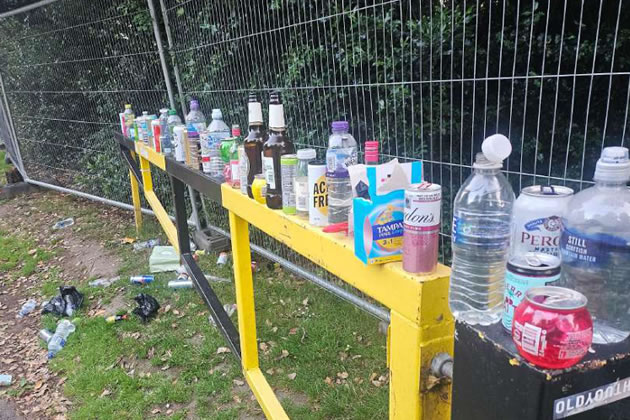
Litter in the park after Krankbrother 2025. Picture: GPGERA
June 14, 2026
Gunnersbury Park’s management has submitted a revised application for long-term planning permission to host major outdoor events, marking the latest chapter in a fraught debate over how the estate should balance cultural programming with the concerns of nearby residents.
The new proposal — significantly scaled back from the original — comes after a year of intense scrutiny, a high-profile licensing review, and a wave of resident complaints.
The Gunnersbury Estate (2026) CIC, which manages the park on behalf of the Gunnersbury Museum and Park Development Trust, is now seeking a five-year planning consent running from January 2027 to December 2031. The application, a revision of the earlier one (ref: P/2025/3274), would allow up to 22 live event days per year, with a total of 115 days on site including build, break and “dark” days. This represents a substantial reduction from the original 10-year proposal and the 28 live days previously sought.
The CIC says the revisions are meaningful rather than cosmetic. It has agreed to reduce the term, cut the number of event days, and voluntarily cap sound levels below those permitted by the recently reviewed premises licence. The new plan limits the loudest events to a maximum of 73dB(A), with at least 12 days restricted to 70dB(A) — “significantly lower than that permitted by the licensing conditions,” the CIC notes.
The shift follows a bruising licensing review in March, triggered by a 300-page submission from Gunnersbury Park Garden Estate Residents Association (GPGERA) citing noise, crowd management, antisocial behaviour and the cumulative impact of large-scale concerts. The review resulted in modified licence conditions but stopped short of the dramatic restrictions some campaigners had sought. The CIC’s updated Event Management Plan Summary, revised this month, states that it has been updated “following the Licence Review Application… to ensure the five-year planning permission aligns with the Licence and its modified conditions.”
However, GPGERA says the revised planning application still falls far short of what residents expected.
In a statement the association said, “The revised application does not appear to address many of the substantive concerns raised by residents during the original planning and licensing processes. The changes are limited, while the consultation has not been formally reopened, no new notices have been placed around the park and residents have had little opportunity to engage meaningfully with the revised proposal.”
Residents, GPGERA says, continue to raise legitimate concerns about noise, crime and antisocial behaviour, pressure on local roads and public transport, harm to wildlife and the cumulative impact of repeated large events on surrounding communities. The association argues that the licensing process earlier this year recognised many of these harms and imposed additional requirements — and that planning should not now contradict that decision by granting blanket permission for impacts the Council has already acknowledged.
GPGERA also questions the financial case underpinning the CIC’s push for multi-year consent. While the CIC argues that long-term planning permission is essential for financial stability — particularly with council service-fee funding due to end in 2028 — the residents’ association notes that last year saw more festival activity than ever, yet the CIC still reported a loss of £81,133.
“This raises reasonable questions about whether the current approach is delivering the financial benefits being claimed,” the statement says. GPGERA is calling for clear, detailed accounts showing event income, subcontractor and operating costs, event-related expenditure and how much revenue is ultimately reinvested in the maintenance and restoration of the park.
The association also argues that residents’ alternative funding proposals have not been given serious consideration, and that the Council and CIC should explore a broader, more resilient strategy rather than relying increasingly on large-scale commercial events. It suggests that Brentford Community Stadium should be considered more fully for additional major events, given its permanent infrastructure and ability to accommodate large crowds without occupying public playing fields.
“Our aim is not to prevent all events,” GPGERA says. *“It is to secure balance through shorter permissions, meaningful annual review, clear limits, independent monitoring, proper consultation and full financial accountability.”* The group says it would welcome an open discussion with the Council, the CIC and event organisers about how that balance can be achieved.
For its part, the CIC argues that the benefits of the revised plan outweigh the impacts, citing more than £35 million in projected economic value to London and Hounslow over the five-year term, alongside hundreds of millions in on- and off-site visitor spending. It also highlights the wider cultural and community benefits, from education programmes to volunteering and skills development.
Historic England, which has previously raised concerns about the impact of events on the park’s heritage landscape, is quoted in the application acknowledging that events are a “vital contributor” to the park’s upkeep. The heritage body also supports the principle of a multi-year permission, saying it would “set up an integrated mid-to-long-term approach” and avoid the piecemeal, repetitive applications that have characterised recent years.
But with residents unconvinced that the revised proposal addresses the core issues, the debate is unlikely to end here. The question of how many events the park should host — and how their impacts should be managed — has become one of the most divisive local issues in the area. The CIC’s concessions may soften some opposition, but the underlying tensions remain.
Like Reading Articles Like This? Help Us Produce More This site remains committed to providing local community news and public interest journalism. Articles such as the one above are integral to what we do. We aim to feature as much as possible on local societies, charities based in the area, fundraising efforts by residents, community-based initiatives and even helping people find missing pets. We’ve always done that and won’t be changing, in fact we’d like to do more. However, the readership that these stories generates is often below that needed to cover the cost of producing them. Our financial resources are limited and the local media environment is intensely competitive so there is a constraint on what we can do. We are therefore asking our readers to consider offering financial support to these efforts. Any money given will help support community and public interest news and the expansion of our coverage in this area. A suggested monthly payment is £8 but we would be grateful for any amount for instance if you think this site offers the equivalent value of a subscription to a daily printed newspaper you may wish to consider £20 per month. If neither of these amounts is suitable for you then contact info@neighbournet.com and we can set up an alternative. All payments are made through a secure web site. One-off donations are also appreciated. Choose The Amount You Wish To Contribute. If you do support us in this way we’d be interested to hear what kind of articles you would like to see more of on the site – send your suggestions to the editor. For businesses we offer the chance to be a corporate sponsor of community content on the site. For £30 plus VAT per month you will be the designated sponsor of at least one article a month with your logo appearing if supplied. If there is a specific community group or initiative you’d like to support we can make sure your sponsorship is featured on related content for a one off payment of £50 plus VAT. All payments are made through a secure web site. |