Residents Group Seeks Review of Gunnersbury Park Licence
Wants a more restrictive and 'community-minded' regime for events
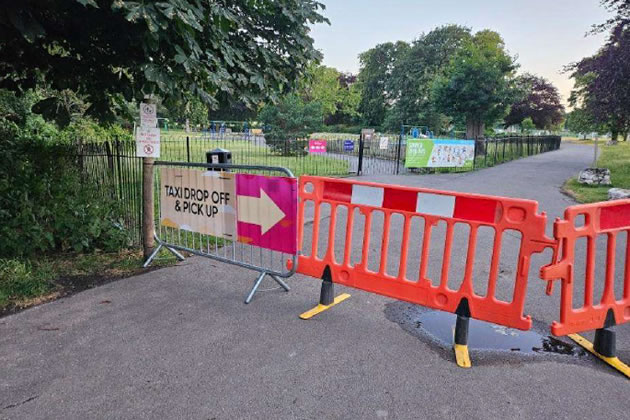
Events restrict access for residents for over 90 days a year. Picture: GPGERA
February 12, 2026
An application for a premises licence review for Gunnersbury Park has been submitted by a local residents’ association. The Gunnersbury Park Garden Estate Residents Association (GPGERA) is making a formal challenge to the licence. This formal challenge targets licence held by the Gunnersbury Estate 2026 Community Interest Company, and seeks to address what residents describe as the intolerable impact of large-scale music festivals and commercial events.
While the council is not obligated to grant a review automatically, the evidence presented contends that the current licensing arrangement may be in direct conflict with the four statutory objectives defined under the Licensing Act 2003: the prevention of public nuisance, the protection of children from harm, the prevention of crime and disorder, and public safety.
Central to the association’s argument is the claim that the park has become a commercialised venue at the expense of its primary purpose as a public recreational space. In 2025 alone, residents documented that public access was restricted for over ninety-eight days due to event infrastructure and closures.
This exclusion is compounded by noise levels that, it is claimed, frequently exceed thresholds set by the World Health Organisation and the Noise Council. Residents have reported that the persistent vibrations and low-frequency bass levels are not merely a nuisance but a disruption to the basic right to quiet enjoyment of their homes.
Councillor Joanna Biddolph has voiced strong support for the residents, saying that, in her view, the volume of evidence provided is likely unprecedented in its clarity and quality, and highlighting that warnings about the current licence were ignored when it was first considered.
The environmental toll on the park forms a significant portion of the evidence submitted in the review. Photographic documentation and soil analysis conducted by the Royal Horticultural Society indicate that parts of the park have suffered irreversible damage. Underneath temporary stages and heavy machinery, soil acidity has reached levels as low as 3.2 pH, which experts suggest renders the land nearly impossible to restore to its natural state.
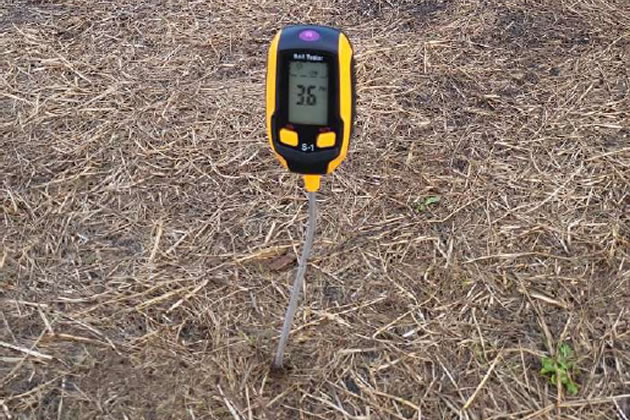
Soil testing has raised concerns that the grass is irreversibly damaged. Picture: GPGERA
Furthermore, the destruction of grass has led to the formation of dust bowls, which residents describe as mini dust tornadoes that pose a respiratory risk to children, the elderly, and those with pre-existing conditions like asthma. This physical deterioration of the landscape is presented as a failure of management that threatens the long-term viability of the park as a green space.
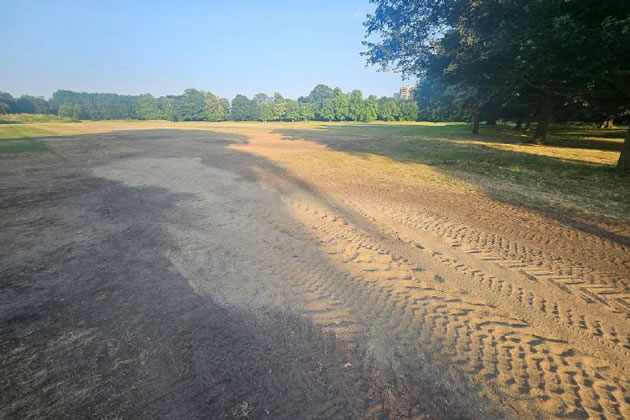
It is claimed that the destruction of the grass has created dust bowls. Picture: GPGERA
Concerns regarding public safety and social order are equally prominent in the application. The residents’ association has detailed numerous instances of antisocial behaviour linked to major events, including the open sale and use of illegal substances and public urination in residential streets. The presence of nitrous oxide canisters and garbage left behind by festival-goers has become a recurring issue for those living in the immediate vicinity.
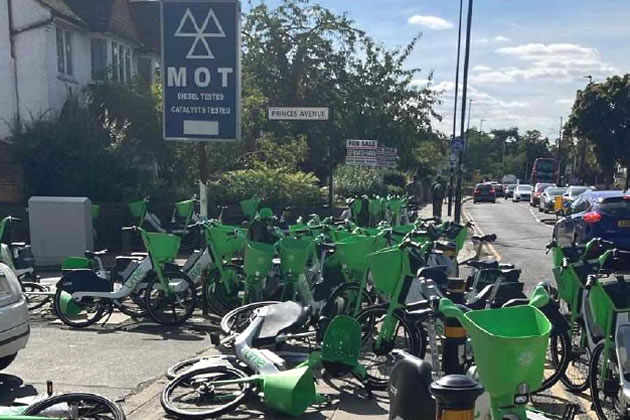
Discarded Lime Bikes on Gunnersbury Lane during a Gunnersbury Park event. Picture: GPGERA
Additionally, the physical layout of events has drawn criticism for obstructing emergency access and creating barriers for disabled residents. Reports describe disabled individuals being forced to navigate uneven grass fields because paved paths were prioritised for promoter vehicles, while playgrounds have occasionally been used as exit routes for large crowds, raising significant safeguarding concerns for local children.
The residents have included comparisons with the licensing frameworks of other major London green spaces, such as Hyde Park, Finsbury Park, and Brockwell Park. They argue that Gunnersbury Park currently operates under a far more permissive regime that lacks the safeguards found elsewhere. This comparison is intended to demonstrate that a more community-minded and restrictive licence is not only desirable but entirely feasible. The association also points to a 2025 High Court ruling involving Brockwell Park, which suggested that events exceeding a twenty-eight-day threshold should be subject to full planning permission, a standard they believe Gunnersbury is currently failing to meet.
The residents are calling for a fair and reasonable new licence that places the community at the heart of decision-making rather than treating the park as a profit-driven venue. Councillor Biddolph has urged residents from across the surrounding areas, including Ealing, Acton, Chiswick, and Brentford, to contribute their own experiences.
A spokesperson for the Gunnersbury Park CIC said, “We are aware that a request has been made for a review of the park’s premises licence and will cooperate fully in the Council’s process. Events at Gunnersbury Park are delivered in line with the licence conditions and in close coordination with our partners. We remain committed to ensuring the park is managed responsibly for the benefit of all our communities and continue to listen to and work with local residents.”
The submission made by the group can be viewed on this page. Comments can be made to licensing@hounslow.gov.uk before 9 March.
Like Reading Articles Like This? Help Us Produce More This site remains committed to providing local community news and public interest journalism. Articles such as the one above are integral to what we do. We aim to feature as much as possible on local societies, charities based in the area, fundraising efforts by residents, community-based initiatives and even helping people find missing pets. We’ve always done that and won’t be changing, in fact we’d like to do more. However, the readership that these stories generates is often below that needed to cover the cost of producing them. Our financial resources are limited and the local media environment is intensely competitive so there is a constraint on what we can do. We are therefore asking our readers to consider offering financial support to these efforts. Any money given will help support community and public interest news and the expansion of our coverage in this area. A suggested monthly payment is £8 but we would be grateful for any amount for instance if you think this site offers the equivalent value of a subscription to a daily printed newspaper you may wish to consider £20 per month. If neither of these amounts is suitable for you then contact info@neighbournet.com and we can set up an alternative. All payments are made through a secure web site. One-off donations are also appreciated. Choose The Amount You Wish To Contribute. If you do support us in this way we’d be interested to hear what kind of articles you would like to see more of on the site – send your suggestions to the editor. For businesses we offer the chance to be a corporate sponsor of community content on the site. For £30 plus VAT per month you will be the designated sponsor of at least one article a month with your logo appearing if supplied. If there is a specific community group or initiative you’d like to support we can make sure your sponsorship is featured on related content for a one off payment of £50 plus VAT. All payments are made through a secure web site. |