Date Set for Gunnersbury Park Licensing Review
Councillors to decide if restrictions on events need to be tightened
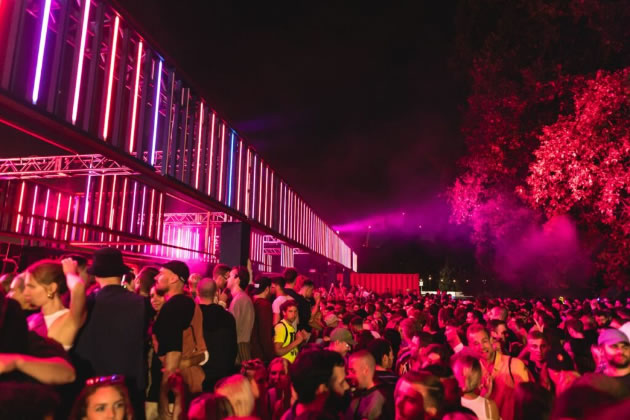
The Waterworks Festival in Gunnersbury Park. Picture: Instagram
March 13, 2026
The future of large-scale events at Gunnersbury Park will be decided later this month when Hounslow Council’s Licensing Panel meets to consider a formal review of the park’s premises licence. The review, scheduled for 27 March, follows a detailed application from the Gunnersbury Park Garden Estate Residents Association, which argues that the current scale and frequency of festivals and concerts has become incompatible with life in the surrounding residential neighbourhood. The case has prompted a strong response from the community, with 105 representations submitted in support of the review and 19 in support of the existing licence, alongside formal statements from the Metropolitan Police, Environmental Health and the Council’s Licensing Enforcement Team.
Residents calling for the review describe a pattern of disruption that they say has intensified in recent years. Many report that amplified music, particularly low-frequency bass, travels far beyond the park boundary and into their homes, even with windows closed. Some say that walls vibrate, sleep is disturbed and gardens become unusable on event days.
Others describe late-night noise from crowds leaving the park, public urination and defecation in front gardens, drug use in nearby streets and a general sense that the area becomes unsafe during major events. Several residents have raised concerns about traffic congestion, blocked driveways and heavy lorries moving through the park during event build and breakdown, which they say creates hazards for children, elderly residents and anyone with mobility issues.
Many also argue that the repeated erection of stages, vehicle tracks and fencing causes lasting damage to the park’s landscape and restricts public access for long periods during the summer, leaving playgrounds, paths and open spaces fenced off or unpleasant to use. For these residents, the cumulative impact of noise, disruption, environmental damage and loss of access has reached a point where they believe the licence must be significantly tightened, with some calling for fewer event days, lower noise limits, independent real-time monitoring, stronger policing and stewarding, and shorter closure periods. A smaller number argue that if improvements cannot be guaranteed, the licence should be suspended or revoked.
Cllr Joanna Biddolph who is supporting the review said, "I have had a huge number of complaints from residents, in Chiswick Gunnersbury ward and beyond, because of the way the festivals have affected them. Although some improvements have been made since 2018, they have not gone far enough and some of them have not been sustained or implemented consistently. Changes, such as to marshaling/stewarding, are made on the spot on the whim of festival organisers; they have an immediate damaging effect on the lives of residents. Residents simply do not believe that there have not been breaches of the licence, such as the now infamous Krankbrother festival last year that caused so much disruption.
"At the Chiswick Area Forum last July, the CIC’s CEO David Bowler said he recognised that he must communicate more effectively to more people yet, only a few months later, he applied for a 10-year blanket planning permission without any warning. There had been no communication about it, none. It is not surprising that residents are cynical. Badly-run events have done a huge amount of damage to the reputation of the CIC. The CIC has not been a good neighbour."
There were 19 formal expressions of opposition to the review. Supporters of the existing licence say that the events are well-run, culturally valuable and financially essential to the park’s survival. They describe Gunnersbury as a vibrant cultural destination that brings world-class music and family events to West London, attracting visitors who might not otherwise discover the park.
Several supporters say they are proud that Gunnersbury has become a major outdoor music venue and argue that the events bring economic benefits to local businesses. They also emphasise that the park and museum rely heavily on commercial income to remain open and well maintained. Without the revenue from events, they argue, the park would deteriorate and council tax payers would face higher costs.
Supporters also point to the park’s compliance record. Both Environmental Health and the Licensing Enforcement Team confirm that there have been no breaches of the premises licence since the CIC took over management in 2018, and that promoters have voluntarily operated below the permitted sound limits. They note that multiple layers of noise monitoring are already in place and that the CIC works closely with police, councils and emergency services to manage events responsibly.
The most detailed operational evidence comes from PC Danny Wood, a Metropolitan Police licensing officer who has worked at Gunnersbury’s major events for the past four years. In his witness statement, he describes the events as well-run within the licensed area and says that he conducts licensing checks every two hours, engaging with bar managers, organisers and security staff to ensure compliance. He reports only two notable incidents inside the event area in recent years.
One involved an artist who asked to take a glass bottle of alcohol on stage during a performance. PC Wood, together with council licensing officers and Trading Standards, refused the request because glass is prohibited. After concerns were raised, he was escorted onto the stage to confirm that no alcohol had been taken on.
The second incident involved theft by an employee, which was handled by the bar operator. PC Wood also refers to a serious incident at a different event in 2025, not run by Festival Republic, after which the CIC refused to allow that organiser to return. While he acknowledges that he has recently been made aware of increasing concerns from residents outside the park, he states that within the licensed footprint the events are well-managed and uphold the licensing objectives.
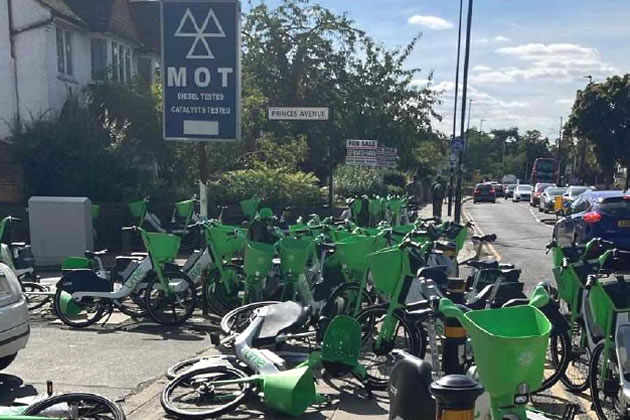
Discarded Lime Bikes on Gunnersbury Lane during a Gunnersbury Park event. Picture: GPGERA
Environmental Health confirms that sound limits have been consistently maintained and proposes a new framework noise management plan that would introduce clearer event categories, reduced sound limits and fixed monitoring points around the park. The Licensing Enforcement Team echoes this view, praising the CIC’s cooperation and suggesting that the licence could be improved through clearer, more enforceable conditions. They note that issues outside the park, such as street disorder, fall partly outside the scope of the licence but agree that some conditions, particularly around litter patrols, could be strengthened.
The Licensing Panel will now have to weigh these competing accounts and decide whether the current licence adequately protects residents while allowing the park to operate sustainably. Their decision will depend on whether the problems described by residents can be directly linked to the licensed activities, whether the licensing objectives are being breached, and whether modifying the licence would be sufficient to address the concerns.
They will also need to consider whether the CIC is taking reasonable steps to mitigate impacts and whether the scale of events is proportionate to what is genuinely needed to sustain the park. Revoking or suspending the licence is an option, but it is a last resort and would only be considered if the Panel concludes that the issues are so serious and persistent that events cannot continue safely or responsibly. Ultimately, the decision will turn on whether the Panel believes that the problems can be managed through tighter conditions or whether the evidence points to a deeper incompatibility between large-scale festivals and the surrounding residential environment.
Members of the public can attend the meeting which takes place in Room s6.10, 6.06 & 6.07 on the 6th Floor of Hounslow House at 5:30pm on Friday 27 March.
Like Reading Articles Like This? Help Us Produce More This site remains committed to providing local community news and public interest journalism. Articles such as the one above are integral to what we do. We aim to feature as much as possible on local societies, charities based in the area, fundraising efforts by residents, community-based initiatives and even helping people find missing pets. We’ve always done that and won’t be changing, in fact we’d like to do more. However, the readership that these stories generates is often below that needed to cover the cost of producing them. Our financial resources are limited and the local media environment is intensely competitive so there is a constraint on what we can do. We are therefore asking our readers to consider offering financial support to these efforts. Any money given will help support community and public interest news and the expansion of our coverage in this area. A suggested monthly payment is £8 but we would be grateful for any amount for instance if you think this site offers the equivalent value of a subscription to a daily printed newspaper you may wish to consider £20 per month. If neither of these amounts is suitable for you then contact info@neighbournet.com and we can set up an alternative. All payments are made through a secure web site. One-off donations are also appreciated. Choose The Amount You Wish To Contribute. If you do support us in this way we’d be interested to hear what kind of articles you would like to see more of on the site – send your suggestions to the editor. For businesses we offer the chance to be a corporate sponsor of community content on the site. For £30 plus VAT per month you will be the designated sponsor of at least one article a month with your logo appearing if supplied. If there is a specific community group or initiative you’d like to support we can make sure your sponsorship is featured on related content for a one off payment of £50 plus VAT. All payments are made through a secure web site. |