Ealing Council Meeting Confirms Annual Budget
Labour says focus on safety and cleanliness rejecting opposition amendment
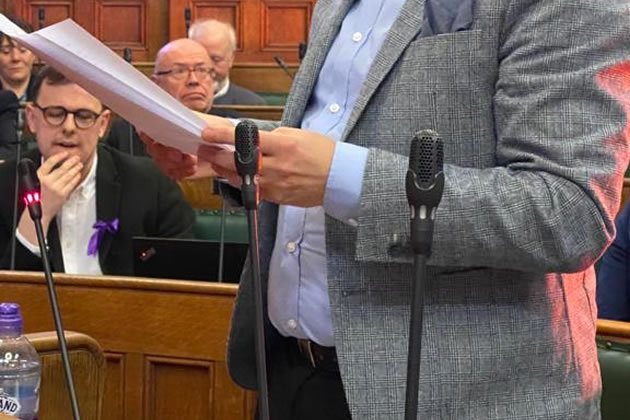
Council leader Peter Mason listens as the Lib Dems present their amendment
March 4, 2026
Ealing Council has approved its budget for the coming financial year, pledging extra investment in street safety, cleaner neighbourhoods and youth facilities while maintaining a council tax rate well below the national average.
The budget was passed at a full council meeting on Tuesday 3 March, with the ruling Labour administration highlighting new funding for CCTV, street lighting and fly-tipping enforcement as central measures designed to make residents feel safer.
Among the headline commitments is £860,000 to install 50 additional CCTV cameras across the borough. The council says the move is aimed at improving public confidence, particularly after dark.
A further £600,000 over three years will go towards street-lighting improvements, including design enhancements intended to improve visibility and reassurance at night. The authority has also allocated £500,000 to create “tidy teams” to remove fly-tipped waste more quickly, citing research that shows dumped rubbish can attract further littering.
The budget includes funding for 50 new alley-gating schemes to deter anti-social behaviour, as well as continued action to remove abandoned vehicles and tackle unregistered houses in multiple occupation (HMOs).
To make waste disposal easier, the council plans to introduce a touring neighbourhood household reuse and recycling service and reduce costs for garden and bulky waste collections.
Council leader Peter Mason said the measures were a response to residents’ concerns about safety. “It’s not enough for politicians to quote statistics about crime when people just don’t feel safe,” he said. “We know residents feel Ealing is a very safe borough in the day, but people need to be reassured that this is a safe borough at night.”
The council is also investing in youth provision, including five new play zones in Greenford, Perivale, Northolt, Southall and Acton. A further £1.6 million will be spent upgrading playgrounds, including the installation of floodlighting to extend their use into autumn and winter evenings.
Alongside these initiatives, the council says it continues to prioritise rising demand for children’s and adults’ social care, home-to-school transport for children with special educational needs, and support for residents in temporary accommodation — all areas where costs have been increasing sharply for local authorities across London and nationally.
Council tax will rise by 2.99%, alongside the additional 2% adult social care precept permitted by government. For a Band D property, the annual charge will be £2,138.53. Of this, £1,628.02 will fund Ealing Council’s services, with £510.51 going to the Mayor of London and the Greater London Authority.
Councillor Steve Donnelly, cabinet member for inclusive economy, said the authority remained financially responsible in a challenging climate. He pointed to the number of councils elsewhere receiving Exceptional Financial Support from central government as evidence of the pressures facing local government.
He also welcomed the government’s move to a three-year local government financial settlement, arguing that it would provide greater stability and allow the council to develop “invest to save” proposals aimed at ensuring long-term financial sustainability.
Like many London boroughs, Ealing faces growing demand in statutory services, particularly social care and housing support, which have consumed an increasing share of council budgets over the past decade. At the same time, core funding from central government has fallen in real terms since 2010, placing additional strain on local finances.
The Ealing Liberal Democrats put forward what they said was a fully costed amendment, which identified £1.6 million in savings to fund alternative priorities.
Central to their proposal was keeping open 10 children’s centres the council plans to close. The Liberal Democrats argued that closures would disproportionately affect vulnerable families and reduce access to early-years support.
Their amendment also proposed cancelling the council’s Stop and Shop Plus scheme, expanding recycling facilities — including for flats above shops — introducing community skips to tackle fly-tipping, increasing street cleaning and leaf removal, carrying out more pavement and road repairs, and commissioning an independent review of the Lammas Park sustainable drainage (SuDS) scheme.
Liberal Democrat councillor Gary Busuttil, the party’s shadow finance spokesperson for performance and council honesty, criticised the administration for voting down what he described as “fully costed and practical measures”. He said the alternative budget would have prioritised frontline services and high streets.
The Labour administration rejected the amendment, maintaining that its own budget strikes the right balance between protecting essential services and investing in visible improvements to neighbourhoods.
Like Reading Articles Like This? Help Us Produce More This site remains committed to providing local community news and public interest journalism. Articles such as the one above are integral to what we do. We aim to feature as much as possible on local societies, charities based in the area, fundraising efforts by residents, community-based initiatives and even helping people find missing pets. We’ve always done that and won’t be changing, in fact we’d like to do more. However, the readership that these stories generates is often below that needed to cover the cost of producing them. Our financial resources are limited and the local media environment is intensely competitive so there is a constraint on what we can do. We are therefore asking our readers to consider offering financial support to these efforts. Any money given will help support community and public interest news and the expansion of our coverage in this area. A suggested monthly payment is £8 but we would be grateful for any amount for instance if you think this site offers the equivalent value of a subscription to a daily printed newspaper you may wish to consider £20 per month. If neither of these amounts is suitable for you then contact info@neighbournet.com and we can set up an alternative. All payments are made through a secure web site. One-off donations are also appreciated. Choose The Amount You Wish To Contribute. If you do support us in this way we’d be interested to hear what kind of articles you would like to see more of on the site – send your suggestions to the editor. For businesses we offer the chance to be a corporate sponsor of community content on the site. For £30 plus VAT per month you will be the designated sponsor of at least one article a month with your logo appearing if supplied. If there is a specific community group or initiative you’d like to support we can make sure your sponsorship is featured on related content for a one off payment of £50 plus VAT. All payments are made through a secure web site. |