Hounslow’s 'Budget for the Future' Described as a Turning Point
Tory opposition raises concerns about over-dependence on fine revenue
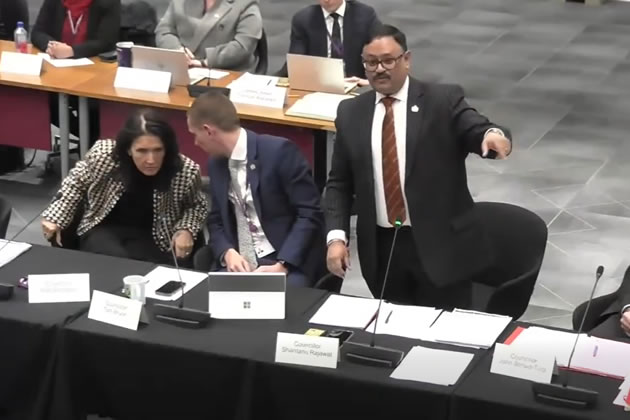
Cllr Shantanu Rajawat defends his administration budget. Picture: Brentford TV
March 5, 2026
Hounslow Council approved its 2026/27 budget at a full council meeting this Tuesday (3 March), rubber stamping a 4.99% increase in council tax. The decision followed a heated debate in which Labour and Conservative councillors presented contrasting views of the borough’s financial position, the pressures facing local services and the choices required to balance the books.
Labour, which holds a large majority on the council, described its plans as a “budget for the future”, arguing that it marked a turning point after what it characterised as years of national funding cuts. The administration highlighted new investment in street cleaning, youth leisure access, green energy infrastructure and major regeneration schemes. Funding commitments include a new heat network, a new leisure centre, improvements to parks and green spaces, and substantial capital spending on council housing and estate upgrades. Council leader Shantanu Rajawat said the budget reflected long-term planning and “fairer choices”, and criticised the Conservative amendment as lacking detail and misunderstanding how the council operates.
The Conservative group rejected that assessment, arguing that their amendment was fully costed and focused on protecting services they said Labour had chosen to reduce, including domestic violence support and homelessness prevention.
They raised concerns about the council’s reliance on more than £5 million of additional income from fines, which they said was uncertain and risked leaving a gap in the council’s finances if the revenue did not materialise. Conservative councillors said their proposals would have redirected resources towards frontline housing and safety services, and reduced what they described as unnecessary spending on communications and internal staffing.
Labour dismissed the Conservative amendment on several grounds, including a proposal to cut a “Community Solutions” team that no longer exists, and what they said was a lack of detail on how £1 million of additional efficiency savings would be achieved without affecting services.
They also criticised a Conservative proposal to sell the Digital Dock workspace in Brentford, arguing that the site is cost-neutral and supports community groups that could be displaced if it were sold. Labour councillors said the amendment demonstrated a misunderstanding of council structures and failed to offer a coherent alternative vision.
Conservative councillors countered that Labour’s budget included unnecessary spending increases and placed too much emphasis on raising revenue through enforcement. Several opposition members used the debate to highlight concerns about domestic violence provision, with Cllr Gabriella Giles arguing that reducing funding in this area “sends the wrong message” to women and girls. The group’s leader, Cllr Peter Thompson, said the Conservative amendment prioritised “food on the table, not pie in the sky”, and argued that the administration should have focused on reducing internal costs before increasing council tax and fees.
The debate also featured criticism of the tone and conduct of the meeting, with Conservative councillors accusing Labour members of treating the discussion lightly, while Labour councillors expressed frustration that opposition groups had not produced a full alternative budget. The Green and Independent councillors did not submit amendments, though Labour noted that they opposed some elements of the administration’s plans, including increased street cleaning and the retention of the Digital Dock.
The political arguments are likely to continue into the run-up to the May local elections, with both parties presenting sharply different interpretations of the borough’s financial health and the best way to protect services during a period of national pressure on local government finances.
Like Reading Articles Like This? Help Us Produce More This site remains committed to providing local community news and public interest journalism. Articles such as the one above are integral to what we do. We aim to feature as much as possible on local societies, charities based in the area, fundraising efforts by residents, community-based initiatives and even helping people find missing pets. We've always done that and won't be changing, in fact we'd like to do more. However, the readership that these stories generates is often below that needed to cover the cost of producing them. Our financial resources are limited and the local media environment is intensely competitive so there is a constraint on what we can do. We are therefore asking our readers to consider offering financial support to these efforts. Any money given will help support community and public interest news and the expansion of our coverage in this area. A suggested monthly payment is £8 but we would be grateful for any amount for instance if you think this site offers the equivalent value of a subscription to a daily printed newspaper you may wish to consider £20 per month. If neither of these amounts is suitable for you then contact info@neighbournet.com and we can set up an alternative. All payments are made through a secure web site. One-off donations are also appreciated. Choose The Amount You Wish To Contribute. If you do support us in this way we'd be interested to hear what kind of articles you would like to see more of on the site – send your suggestions to the editor. For businesses we offer the chance to be a corporate sponsor of community content on the site. For £30 plus VAT per month you will be the designated sponsor of at least one article a month with your logo appearing if supplied. If there is a specific community group or initiative you'd like to support we can make sure your sponsorship is featured on related content for a one off payment of £50 plus VAT. All payments are made through a secure web site. |