Green Heat Network Key to Council Meeting Climate Targets
Borough focusing on decarbonisation until the end of the decade
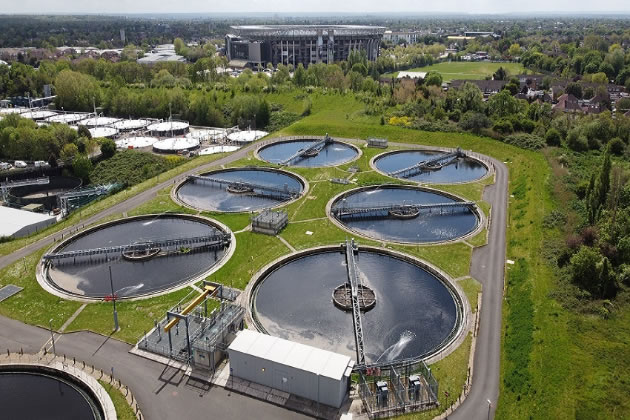
The plan is to capture low-carbon heat from treated water at Mogden Sewage Works. Picture: Thames Water
December 12, 2025
The prospects for Hounslow Council’s climate emergency programme are considered in two reports due to be presented at a forthcoming council meeting. Both point to a switch away from trying to reduce emissions across the borough, which has proven impractical given population growth and planned developments, and towards reducing the carbon usage that the council generates through its activities.
Hounslow Council has reached a pivotal stage in its climate emergency programme and the Cabinet will learn more this Tuesday (16 December) about the course for the borough’s decarbonisation efforts through to 2030. At the heart of the strategy is the proposed borough-wide Green Heat Network, a project that the council hopes will transform energy use locally and provide a model for other London authorities.
Since declaring a climate emergency in 2019, Hounslow has pursued ambitious targets to achieve net zero council operations by 2030 and to influence wider borough emissions.
Achievements to date include decarbonisation measures installed at 24 corporate buildings, 38 schools and 150 homes, the transition of the waste and recycling fleet to Hydrotreated Vegetable Oil which cuts emissions by up to 90 percent compared to diesel, the development of a Low Carbon Procurement Toolkit now embedded in council practice, and securing £10.5 million in grant funding to deliver the first phase of the Heat Network.
The updated Climate Emergency Action Plan for 2026 to 2030 shifts emphasis from measuring emissions reductions to tracking the number of assets decarbonised, which the council argues is a more transparent and practical approach.
The Heat Network is central to Hounslow’s next phase. It aims to connect public buildings, social housing, and eventually commercial and residential properties to a shared low-carbon heating system. Funding of £10.5 million has already been secured from the government’s Green Heat Network Fund. The council plans a Golden Share Joint Venture with a private sector development partner, giving Hounslow strategic oversight while reducing financial risk. Phase 1 is expected to unlock around £45 million of private investment, with the full cross-borough network potentially exceeding £400 million. The benefits are expected to include warmer homes, cheaper energy, cleaner air, and new local jobs in the green economy.
Hounslow’s planned Green Heat Network will work by capturing low-carbon heat from treated water at Mogden Sewage Works in Isleworth, transferring it via heat pumps into a clean water system, and distributing that heat through insulated underground pipes to homes, schools, public buildings and businesses across the borough.
While the council acknowledges risks, particularly procurement complexity and reduced direct control, given the secured funding, Cabinet approval of the delivery model, and strong alignment with national net zero targets, the Heat Network appears highly likely to proceed. The council has already received letters of support from major public sector partners, including West Middlesex Hospital, signalling demand for connection. The main challenges lie in procurement and governance, ensuring sufficient investment for large-scale decarbonisation of schools and housing, and maintaining public trust during a transition that will reshape local energy infrastructure.
Hounslow’s efforts reflect a broader trend across London boroughs. Islington has pioneered district heating through its Bunhill Energy Centre, supplying homes and schools with waste heat from the Tube. Southwark and Greenwich are developing similar networks, backed by government funding. The Mayor of London’s Renewables Fund has supported solar PV upgrades in schools, including four in Hounslow. London boroughs are increasingly turning to heat networks and strategic energy partnerships as the only viable way to deliver large-scale decarbonisation. The capital’s dense housing stock and high energy demand make shared infrastructure solutions more practical than piecemeal retrofits.
Hounslow’s climate strategy has moved from planning to delivery, with the Green Heat Network representing its most ambitious project yet. If successful, it will not only cut emissions but also reshape how energy is supplied across the borough, offering a blueprint for other London councils. The next year will be critical, with procurement decisions, partnership agreements, and early construction determining whether the Heat Network becomes a flagship success or stalls under financial and logistical pressures.
For now, the momentum and the funding suggest Hounslow could be on track to deliver one of London’s most significant local climate infrastructure projects.
Like Reading Articles Like This? Help Us Produce More This site remains committed to providing local community news and public interest journalism. Articles such as the one above are integral to what we do. We aim to feature as much as possible on local societies, charities based in the area, fundraising efforts by residents, community-based initiatives and even helping people find missing pets. We've always done that and won't be changing, in fact we'd like to do more. However, the readership that these stories generates is often below that needed to cover the cost of producing them. Our financial resources are limited and the local media environment is intensely competitive so there is a constraint on what we can do. We are therefore asking our readers to consider offering financial support to these efforts. Any money given will help support community and public interest news and the expansion of our coverage in this area. A suggested monthly payment is £8 but we would be grateful for any amount for instance if you think this site offers the equivalent value of a subscription to a daily printed newspaper you may wish to consider £20 per month. If neither of these amounts is suitable for you then contact info@neighbournet.com and we can set up an alternative. All payments are made through a secure web site. One-off donations are also appreciated. Choose The Amount You Wish To Contribute. If you do support us in this way we'd be interested to hear what kind of articles you would like to see more of on the site – send your suggestions to the editor. For businesses we offer the chance to be a corporate sponsor of community content on the site. For £30 plus VAT per month you will be the designated sponsor of at least one article a month with your logo appearing if supplied. If there is a specific community group or initiative you'd like to support we can make sure your sponsorship is featured on related content for a one off payment of £50 plus VAT. All payments are made through a secure web site. |