Hounslow Council's 'Hefty' Fly-Tipping Fines Spark Debate
Critics raise concern about fairness and heavy handed enforcement
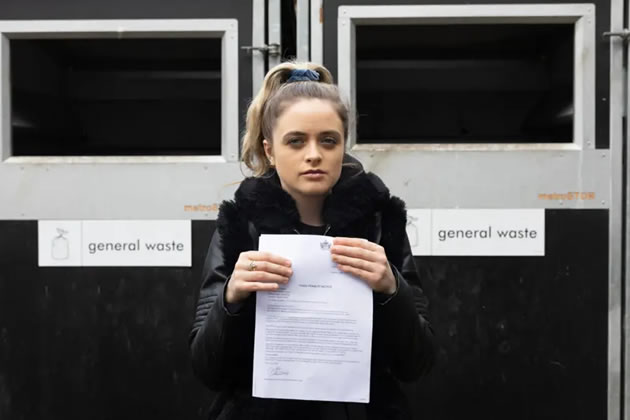
Single mother and mental health nurse Loretta Alvarez with the £1,000 fine she received
November 13, 2025
A growing number of councillors, residents and business owners in Hounslow are raising concerns about the borough’s approach to fly-tipping enforcement, following a series of high-profile fines that critics say disproportionately penalise minor infractions and risk undermining public trust.
Among the most contentious recent cases is that of Loretta Alvarez, a 26-year-old mental health nurse and single mother from Feltham, who was issued a £1,000 fine after placing a cardboard envelope next to overflowing communal bins outside her flat. Ms Alvarez says she believed she was acting responsibly and was shocked to be held accountable for a wider pile of dumped rubbish that she claims was not hers.
“It’s been so stressful,” she said. “I didn’t want this to happen, and I wouldn’t want it to happen to someone else. I’ve been trying to juggle this alongside work and being a mum—it’s been hard.”
The council has since paused the fine while investigating, but has not cancelled it. In a statement, Councillor Pritam Grewal, Cabinet Member for Community Safety, defended the decision: “Littering includes leaving waste anywhere in public apart from in a bin, regardless of whether bins are full. While we accept that no one likes receiving a fine, residents expect us to tackle the offence and the offenders.”
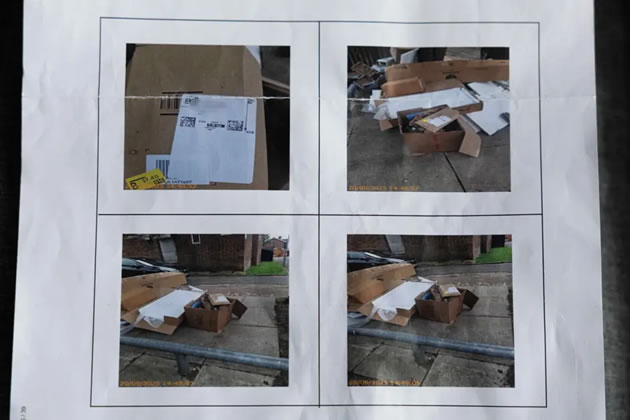
Ms Alvarez says she left an envelope but not the rest of the packaging found by the overflowing recycling bins
The case has reignited debate over the borough’s zero-tolerance policy, which saw fixed penalty notices for littering and fly-tipping sharply increased earlier this year. Councillor Salman Shaheen told Cabinet last Tuesday (11 November), ) "In an ideal world no one would drop a cigarette butt on the floor, no one would fly-tip, everyone would park in the right place, and we would have a beautiful utopia on our streets.
"We don't live in that world, and we have to have enforcement, we have to have penalties to ensure we get the neighbourhoods we want.
"It brings in money which the council can use productively to improve our streets but also hopefully it acts as a deterrent.
"Recently we massively increased the fixed penalty notices on littering and fly-tipping. Again, hopefully, no one ever gets whacked with one of those hefty fines, but we should fine people to the hilt as long as they are doing so because that's how we create the neighbourhoods that people want to live in and want to see."-
But others argue the policy is being applied too rigidly. Councillor Joanna Biddolph highlighted several cases in her Chiswick Gunnersbury ward where fines were issued without clear evidence, only to be overturned after councillor intervention.
She says there four of her constituents received notices of fines for alleged flytipping although three of these have been cancelled, one after a “stressful and aggressive appeals process” followed by councillor intervention. The fourth may be subject to challenge in court as the evidence for flytipping is a flattened piece of cardboard which was allegedly found in an area used by rough sleepers.
Cllr Biddolph advises, “If you are unjustly ‘whacked with one of those hefty fines’ and your appeal is not successful, please contact a councillor. Justice should not be overruled by revenue-raising in a council that seems unable to stick to its budget or get the basics right.”
Brentford West Green Party councillor Guy Lambert has also been in contact with at least three constituents who have received these fines. One told him that she had picked up some medication from her place of work and walked home to the boat where she lives. On the way she passed the communal recycling bins next to O'Riordan's pub where other fines had been issued. Having extracted her medication from the cardboard box it arrived in she put the remains of the box on the bin which was full to overflowing and later received a PCN.
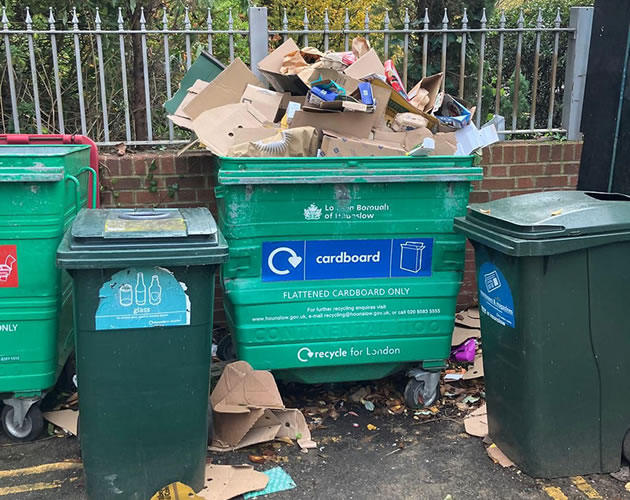
The bin near O'Riordan's pub in Brentford where a woman was fined for depositing a medicine box. Picture: Cllr Guy Lambert
Another case drawing attention is that of Carmen Parfenie, a Brentford business owner who was fined £1,000 for placing a flattened cardboard box in a recycling bin at a nearby housing estate. Ms Parfenie, who runs a sustainability-focused shop and serves as a school governor, said she believed she was recycling responsibly and found the council’s response “intimidating and disproportionate.”
“The punishment should fit the crime,” she said. “Instead, the council has chosen the maximum possible penalty for something that caused no harm and was done in good faith.”

Carmen Parfenie says she left one item in a recycling bin
Hounslow Council has refused Ms Parfenie’s appeal and maintains that businesses must use authorised waste carriers. It says that enforcement is necessary to tackle the borough’s high levels of illegal dumping. With over 27,000 fly-tipping incidents recorded last year and an annual clean-up cost of £370,000, officials say strong deterrents are needed and increased levels for fines are part of that process..
Yet critics argue that the current approach risks alienating residents who are trying to do the right thing and fails to target large scale fly-tippers who are the real problem. Opposition leader Councillor Peter Thompson said, “£1,000 fines for ‘trying to recycle’ miss the point. People want the council to focus on major offenders, not ordinary residents.”
For now, residents are being urged to contact their local councillor if they believe they’ve been unfairly fined—and to remain vigilant about how and where they dispose of waste.
Written with contributions from Philip James Lynch - Local Democracy Reporter
Like Reading Articles Like This? Help Us Produce More This site remains committed to providing local community news and public interest journalism. Articles such as the one above are integral to what we do. We aim to feature as much as possible on local societies, charities based in the area, fundraising efforts by residents, community-based initiatives and even helping people find missing pets. We've always done that and won't be changing, in fact we'd like to do more. However, the readership that these stories generates is often below that needed to cover the cost of producing them. Our financial resources are limited and the local media environment is intensely competitive so there is a constraint on what we can do. We are therefore asking our readers to consider offering financial support to these efforts. Any money given will help support community and public interest news and the expansion of our coverage in this area. A suggested monthly payment is £8 but we would be grateful for any amount for instance if you think this site offers the equivalent value of a subscription to a daily printed newspaper you may wish to consider £20 per month. If neither of these amounts is suitable for you then contact info@neighbournet.com and we can set up an alternative. All payments are made through a secure web site. One-off donations are also appreciated. Choose The Amount You Wish To Contribute. If you do support us in this way we'd be interested to hear what kind of articles you would like to see more of on the site – send your suggestions to the editor. For businesses we offer the chance to be a corporate sponsor of community content on the site. For £30 plus VAT per month you will be the designated sponsor of at least one article a month with your logo appearing if supplied. If there is a specific community group or initiative you'd like to support we can make sure your sponsorship is featured on related content for a one off payment of £50 plus VAT. All payments are made through a secure web site. |