Rupa Huq Explains Her Assisted Dying Vote
Local MP concerned about impact on non-native speakers
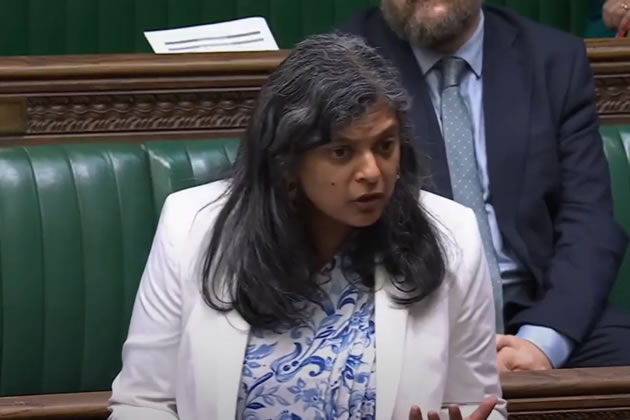
Rupa Huq speaking in the Assisted Dying debate last Friday
June 30, 2025
Rupa Huq, the MP for Ealing Central and Acton, has explained her reasons for voting against the Assisted Dying Bill.
She spoke in opposition to the proposal in the House of Commons on Friday (27 June) as months of emotional debates and national discussion culminated in its narrow victory with 314 MPs for and 291 against.
Dr Huq said, “The tight margin it passed by reflects the divided nature of parliament in agreeing any sort of consensus on this issue. The vote has been the most consequential vote in the career of many of the MPs involved. The vote was a great advertisement for our parliamentary system,
600 MPs involving themselves in a well-mannered debate on an issue that has got the nation discussing: how would you vote on assisted dying?”
The MP says the vote was a difficult choice which highlighted her experience in dealing with the social complexities of healthcare. The primary reason for her being unable to support the bill was concern for the way that it might disproportionately affect non-native speakers like her own mother.
She added, “A younger me would have been 100% behind this Bill. I am very pro body autonomy when it comes to abortion, but ten years of being an MP has exposed me to coercion, duress, the billionaire price of London property, and elder abuse.”
Her reservations with the bill were practical seeing how those who are not native speakers might have their agency denied by health professionals in an overwhelmed system. She highlighted that in our current healthcare system ethnic minorities already suffer health inequalities so she questions, why would assisted dying be any different? She felt, given these nuances, the time spent on the bill seemed rushed and inadequate for what was literally a matter of life and death.
During the debate in parliament, the local MP cited her personal experiences of this, “My mum’s GP had a clear contempt for her accented words. At every appointment she would say to her, ‘One question only’. As my mum grew frailer and began to lose the power of speech, she reverted to her mother tongue and was seen by hospital teams as an annoyance, a time waster, and bed blocker.”
She observed that while the scene from campaigners outside the House of Parliament was one of jubilation and relief, as the result of the vote was announced, the mood inside Parliament was a more muted.
The bill now enters the House of Lords where it will receive further scrutiny. How much it can be changed or indeed, whether or not it can be blocked is unclear. As a Private Member’s Bill, that was not part of a party manifesto and passed by such a narrow margin, it is far from certain that it will ever form the basis of a new law.
Like Reading Articles Like This? Help Us Produce More This site remains committed to providing local community news and public interest journalism. Articles such as the one above are integral to what we do. We aim to feature as much as possible on local societies, charities based in the area, fundraising efforts by residents, community-based initiatives and even helping people find missing pets. We've always done that and won't be changing, in fact we'd like to do more. However, the readership that these stories generates is often below that needed to cover the cost of producing them. Our financial resources are limited and the local media environment is intensely competitive so there is a constraint on what we can do. We are therefore asking our readers to consider offering financial support to these efforts. Any money given will help support community and public interest news and the expansion of our coverage in this area. A suggested monthly payment is £8 but we would be grateful for any amount for instance if you think this site offers the equivalent value of a subscription to a daily printed newspaper you may wish to consider £20 per month. If neither of these amounts is suitable for you then contact info@neighbournet.com and we can set up an alternative. All payments are made through a secure web site. One-off donations are also appreciated. Choose The Amount You Wish To Contribute. If you do support us in this way we'd be interested to hear what kind of articles you would like to see more of on the site – send your suggestions to the editor. For businesses we offer the chance to be a corporate sponsor of community content on the site. For £30 plus VAT per month you will be the designated sponsor of at least one article a month with your logo appearing if supplied. If there is a specific community group or initiative you'd like to support we can make sure your sponsorship is featured on related content for a one off payment of £50 plus VAT. All payments are made through a secure web site. |