Ealing Council Set to Write Off Millions After Broadway Living Failure
Remaining projects to be brought in-house as company deemed unviable
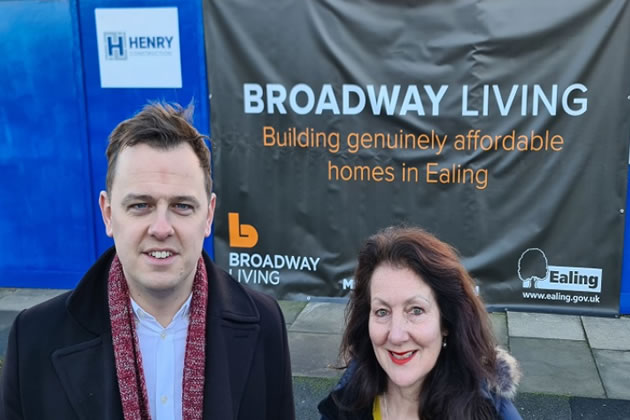
Cllrs Peter Mason and Lauren Wall at Henry Construction site for a Broadway Living scheme in 2022. Picture: Ealing Council
June 11, 2026
Ealing Council has decided to pull the plug on its arms length housing venture after the scheme left it needing to make huge write-offs and delivered just 180 homes as opposed to the thousands that were promised.
The Cabinet voted on Wednesday (10 June) to wind up Broadway Living Ltd (BL) and its regulated subsidiary Broadway Living Registered Provider Ltd (BLRP), drawing a line under a housing venture that cost the borough millions and delivered a fraction of the homes it promised.
The decision follows two years of independent reviews that concluded the companies were no longer financially viable. All properties and assets will be transferred back to the council, and both companies will enter a solvent wind-down through a members' voluntary liquidation.
Broadway Living was established in 2014 as a wholly council-owned company, designed to sidestep the borrowing constraints that traditionally limited councils' ability to build housing. Its subsidiary BLRP was created between 2018 and 2020 as a regulated provider to hold and manage affordable rented homes. In November 2020, the council lent the combined entity £400 million with an ambitious target: to deliver more than 1,000 new affordable homes in an initial phase, with a longer-term vision of over 7,000 units across the borough. By borrowing directly and lending on to subsidiaries, the council was able to take advantage of lower interest rates available to local authorities.
Operating at arm's length gave Broadway Living commercial flexibility, and interest rates remained low enough to make borrowing look manageable. But the environment shifted sharply. Construction costs surged post-pandemic, interest rates rose significantly, and in mid-2023, Henry Construction — BLRP's main contractor — went insolvent, leaving four major development schemes incomplete and stranded.
By the time independent consultants Campbell Tickell completed their appraisal in April 2025, the conclusion was stark: "doing nothing is not a realistic option." Cash flows were, in their words, "simply not sufficient to meet operating costs and financing costs of the loans." A second review by Grant Thornton, completed in October 2025 under the codename "Project Fleetwood," put hard numbers on the damage. The council had advanced approximately £42.3 million in loans and equity to the two companies. The combined value of their housing assets stood at only around £26.7 million — meaning the companies were sitting in negative equity of roughly £15 million, before the cost of completing their stalled projects was even factored in.
Faced with a choice of five broad options — do nothing, inject more public money, hibernate the companies, sell assets to a third party, or bring everything back in-house — the Cabinet chose the last. All properties owned by BLRP and BL will be transferred to the council's Housing Revenue Account (HRA), which will borrow approximately £39.855 million to fund the purchases. The council will then write off the shortfall between what it lent and what it recovers from the asset values.
Based on current draft valuations, the council expects to recover around £36.348 million, leaving a net debt and equity write-off of £6.550 million. This figure — described in the Cabinet report as a "one-off hit" — does not include the additional costs of completing the four stalled development sites, which will be the subject of a separate report to Cabinet in July.
The outstanding loan balance will be charged to the council's General Fund through Minimum Revenue Provision spread over 50 years. Officers expect the annual impact on the General Fund to be modest — around £25,000 per year — once the return on reinvested cash is netted off.
The council must also write off £2.256 million in outstanding debts owed to it by the subsidiaries, already impaired in the 2025/26 accounts, which will be charged to the General Fund.
The headline numbers, as presented to Cabinet, are as follows:
- Total loans and equity advanced to BL and BLRP: approximately £42.9 million (£40.761m in loans plus £2.136m equity in BL)
- Capital cost of transferring assets to the HRA: £39.855 million, to be funded by borrowing
- Estimated asset recovery: £36.348 million
- Net loan and equity write-off: £6.550 millio
- Debtors written off to the General Fund: £2.256 million
- Professional fees: approximately £250,000, potentially higher
- Stamp Duty Land Tax on residential properties: £3.507 million (relief may be available)
- Annual net cost to the HRA after transfer: approximately £707,000 per year (before Right to Buy receipts or other offsets)
The Liberal Democrats, speaking through Councillor Gary Malcolm at Wednesday's Cabinet meeting, put the total closure cost at "nearly £40m, funded by borrowing," leaving the council "£6.5m worse off when the value of the homes is taken into account, but before the additional costs of managing and finishing the stalled projects."
Councillor Jon Ball, the Liberal Democrats' shadow cabinet spokesperson for Planning, Licensing and Regeneration, was sharply critical. "Ealing Labour should have grasped the nettle and closed down this failed experiment years ago," he said. "Allowing it to limp on has increased the cost to council taxpayers. The sites at Deans Gardens and around the borough still lie empty and will cost the council more of our money to demolish before new schemes for those sites can start."
The Liberal Democrats also alleged that the scale of Broadway Living's failure had been known for years — pointing to officer admissions at public scrutiny in 2023 that the business model was unviable — and accused Labour of delaying the announcement until after May's local elections.
The council has been at pains to stress that no tenants will lose their homes. BLRP currently manages a portfolio including properties at Dearden House in Ealing, Matlock Court in Hanwell, and Buckingham Avenue in Perivale, among others. BL manages market-rent and intermediate-rent units at sites including Eastcote Lane and Arthur Court. All will transfer to the council.
For most tenants, the practical change will be limited: their landlord will change from BL or BLRP to the council, and their rents will remain at current levels on the date of transfer. Assured tenancies held with BLRP will automatically convert to secure tenancies, giving residents additional protections — including the Right to Buy, subject to eligibility.
The existing property management contract with Lambert Smith Hampton will be novated to the council so that day-to-day services are uninterrupted. The council says it will set up a dedicated phone line for residents and issue written guidance explaining the changes and their rights.
Shared owners in BLRP properties will have their leases assigned to the council and will retain the right to staircase — purchasing further shares over time — as before.
Residents are entitled to be consulted before the transfer is finalised. The Cabinet report makes clear that BLRP will carry out a formal consultation in line with regulatory requirements, and that the council will consider the results before proceeding.
The Cabinet report itself notes that "a number of councils (across London and nationally) have wound up or scaled back their housing companies in recent years after encountering similar challenges," pointing to sector-wide difficulties with the local authority housing company model.
The logic of off-balance-sheet housing vehicles was compelling when borrowing was cheap and construction costs were stable. Rising interest rates and contractor insolvencies have exposed the structural fragility of that model. The removal of the HRA debt cap in 2018 — originally one of the key justifications for creating Broadway Living — has also reduced the rationale for keeping housing development at arm's length from the council.
By the council's own reckoning, Broadway Living spent £71 million to deliver just 180 of the 1,138 homes it had promised the Greater London Authority. The four incomplete development sites — at Shackleton Road, Wood End, Chesterton and Evesham, and Norwood Road — will now transfer to the council, which will decide what to do with them in the coming months.
The council says it intends to continue delivering affordable housing, but directly rather than through a subsidiary. Its Housing and Regeneration department has already been expanding its in-house development team, and officers believe the simplification of governance will improve accountability and speed of decision-making.
A further Cabinet report is expected in July covering the four stalled sites and setting out options for how and when they might be brought forward. The total additional cost of completing or disposing of those sites is not yet known.
The Regulator of Social Housing, which was self-reported to by BLRP in Spring 2025, has been involved throughout and will need to consent to BLRP's deregistration and the transfer of its properties. The GLA, which funded some of the homes, must also give consent to the disposals.
For now, the experiment is over. Whether Ealing's direct housing delivery model proves more successful — and at what cost to the borough's finances — will take years to judge.
Like Reading Articles Like This? Help Us Produce More This site remains committed to providing local community news and public interest journalism. Articles such as the one above are integral to what we do. We aim to feature as much as possible on local societies, charities based in the area, fundraising efforts by residents, community-based initiatives and even helping people find missing pets. We've always done that and won't be changing, in fact we'd like to do more. However, the readership that these stories generates is often below that needed to cover the cost of producing them. Our financial resources are limited and the local media environment is intensely competitive so there is a constraint on what we can do. We are therefore asking our readers to consider offering financial support to these efforts. Any money given will help support community and public interest news and the expansion of our coverage in this area. A suggested monthly payment is £8 but we would be grateful for any amount for instance if you think this site offers the equivalent value of a subscription to a daily printed newspaper you may wish to consider £20 per month. If neither of these amounts is suitable for you then contact info@neighbournet.com and we can set up an alternative. All payments are made through a secure web site. One-off donations are also appreciated. Choose The Amount You Wish To Contribute. If you do support us in this way we'd be interested to hear what kind of articles you would like to see more of on the site – send your suggestions to the editor. For businesses we offer the chance to be a corporate sponsor of community content on the site. For £30 plus VAT per month you will be the designated sponsor of at least one article a month with your logo appearing if supplied. If there is a specific community group or initiative you'd like to support we can make sure your sponsorship is featured on related content for a one off payment of £50 plus VAT. All payments are made through a secure web site. |