Ealing Council Sets Ambitious Targets for Housing Starts
Aims to boost supply of 'genuinely affordable' units over next five years
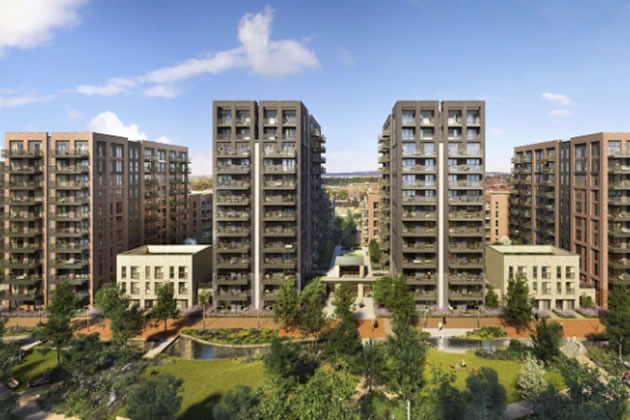
The council recently purchased flats in a Southall development to provide as affordable units. Picture: Ealing Council
August 12, 2025
Ealing Council has unveiled its housing strategy for 2025 to 2030, Great Homes, Better Lives, outlining an ambitious plan to tackle the borough’s acute housing challenges. The strategy aims to ensure that every resident has access to a good quality, genuinely affordable housing unit within a thriving community where they can live healthier and happier lives.
It is built around four key priorities: increasing the supply of genuinely affordable housing units, improving the quality and safety of housing and neighbourhoods, ensuring housing is well-managed across all tenures, and preventing housing crises while promoting inclusion and independence.
The borough faces mounting housing pressures, including high demand for social housing, rising homelessness, and affordability challenges across both public and private sectors. One in 42 households is homeless or at risk of homelessness, and the borough has the fourth-highest level of rough sleeping in London. The average wait for a three-bedroom socially rented housing unit is currently 14 years.
Despite these challenges, Ealing Council has performed relatively strongly in recent years compared with other London authorities. Between 2021/22 and 2023/24, the borough averaged 1,449 net housing additions annually. In 2022/23 alone, Ealing delivered 2,100 new housing units—more than any other London borough. Over the past three years, nearly 1,400 genuinely affordable housing units were secured, with plans underway for 800 more. More than 40 percent of housing units in new developments have been affordable, exceeding the London Plan’s fast-track threshold of 35 percent. The council has also invested £250 million in repairing, retrofitting, and improving existing housing stock, and now has over 5,000 Build-to-Rent housing units, the third-highest total in London.
Looking ahead, the council faces rising housing targets. The current London Plan sets a goal of 2,157 housing units per year, but under the government’s standard methodology, this could rise to 3,407 annually—more than double current delivery rates. To meet these demands, the strategy outlines a commitment to exceed 40 percent affordable housing in new developments, with a strategic target of 50 percent where feasible. A new Affordable Housing Investment Plan will prioritise social rent and intermediate tenures, supported by £322 million earmarked for investment in council-owned housing stock. The council also plans to retrofit 2,200 housing units over three years and ensure all new council housing meets Passivhaus or equivalent standards. Estate regeneration and community-led housing will be expanded, with 5,000 housing units already in the development pipeline.
The strategy also pledges to reduce reliance on emergency temporary accommodation, improve standards in the private rented sector through licensing and enforcement, and establish a new intermediate housing register to support middle-income households and key workers. Special attention will be given to vulnerable groups, including older residents, care leavers, refugees, and those experiencing homelessness or rough sleeping.
The council says that central to the strategy is a commitment to work closely with residents, community groups, and housing providers to ensure housing services are responsive, inclusive, and transparent. Progress will be tracked through a delivery plan and reviewed annually, with a full strategic review scheduled after five years.
Like Reading Articles Like This? Help Us Produce More This site remains committed to providing local community news and public interest journalism. Articles such as the one above are integral to what we do. We aim to feature as much as possible on local societies, charities based in the area, fundraising efforts by residents, community-based initiatives and even helping people find missing pets. We've always done that and won't be changing, in fact we'd like to do more. However, the readership that these stories generates is often below that needed to cover the cost of producing them. Our financial resources are limited and the local media environment is intensely competitive so there is a constraint on what we can do. We are therefore asking our readers to consider offering financial support to these efforts. Any money given will help support community and public interest news and the expansion of our coverage in this area. A suggested monthly payment is £8 but we would be grateful for any amount for instance if you think this site offers the equivalent value of a subscription to a daily printed newspaper you may wish to consider £20 per month. If neither of these amounts is suitable for you then contact info@neighbournet.com and we can set up an alternative. All payments are made through a secure web site. One-off donations are also appreciated. Choose The Amount You Wish To Contribute. If you do support us in this way we'd be interested to hear what kind of articles you would like to see more of on the site – send your suggestions to the editor. For businesses we offer the chance to be a corporate sponsor of community content on the site. For £30 plus VAT per month you will be the designated sponsor of at least one article a month with your logo appearing if supplied. If there is a specific community group or initiative you'd like to support we can make sure your sponsorship is featured on related content for a one off payment of £50 plus VAT. All payments are made through a secure web site. |