New Guidance Could Boost Cross Pavement EV Charging
London Councils recommending gullies to reduce potential trip hazards
The new trains are 'the most complex ever' to be introduced on the underground. Picture: London Councils
July 16, 2025
London Councils, the body which co-ordinates policy across boroughs in the capital, has t published new guidance about cross-pavement electric vehicle (EV) charging.
At present, councils have had differing policies on residents using their domestic electricity supply to charge their vehicles on the road outside their homes. Restrictions on this in some boroughs has forced EV owners to recharge their cars using more expensive and less reliable options such as lamppost chargers.
The new guidance has been issued following the government's recent announcement of £25 million in funding for local authorities to install cross-pavement EV charging solutions across the country.
As the UK’s leader in EV uptake, London is home to 193,000 plug-in cars and vans, with that number expected to rise to 1.4 million by 2030.2 While 90% of EV users prefer the cost savings and convenience of home charging, 61% of Londoners do not have access to off-street parking— creating a major barrier to EV uptake in the capital.
This growing gap has led to a rise in trailing charging cables across pavements, creating trip hazards and accessibility risks, especially for older residents and those with mobility or visual impairments.
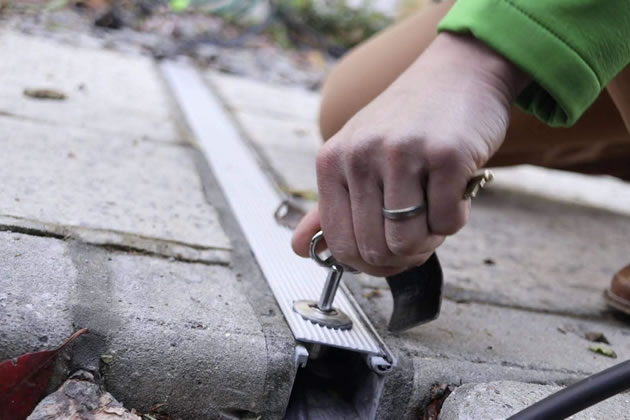
London Councils is recommending either a surface 'gully' or a system buried under the pavement. It says these installations are quick—typically completed within 1.5 to 3 hours—and blend into existing street materials to maintain safe pedestrian access. The report states that installation costs currently range from £1,000 - £1,500.
The report makes it clear that temporary cross-pavement solutions such as flexible cable covers or mats—regardless of whether they have warning strips—are not approved or supported by most local authorities. These are broadly banned due to concerns around safety, accessibility, and legal liability.
Such solutions are seen as increasing the risk of trips, particularly for people with visual impairments, older adults, or those with mobility issues. Moreover, they can deteriorate under foot traffic or weather conditions, potentially leading to electrical hazards. From a legal perspective, the use of these temporary covers can expose residents to personal liability for any injury or damage caused.
Instead, the report encourages the adoption of permanently installed, council-approved cross-footway channels that are embedded flush with the pavement, as these are specifically designed to mitigate risk and comply with safety standards
Cross-pavement solutions require approval from the local authority and may not be suitable for every household. However, many London boroughs are actively preparing to trial these technologies as they assess their potential for wider rollout.
Enfield Council trialled a cross-pavement charging channel with Kerbo Charge in 2024. Now available borough-wide, it allows residents to charge using cheaper home energy tariffs and supports Enfield’s goal of becoming carbon neutral by 2040. Bromley Council has rolled out a similar scheme using the Gul-e solution. Eligible residents can install a flush-mounted gully outside their homes, enabling safer, more affordable EV charging.
Despite these reported successes, numerous challenges are identified in the London Councils report. These include safety concerns, legal liabilities, planning and licensing complexities, accessibility limitations, and a lack of clear national standards or technical guidance. Local authorities must also manage installation, maintenance, enforcement, and public engagement, often without sufficient funding or expertise. Further complications arise from the need to protect footways, coordinate with utilities, manage resident disputes over parking, and assess property suitability.
The report concludes that while cross-footway charging can support EV adoption and environmental goals, implementation requires careful planning and adequate support. It calls for clearer national standards, more funding, shared best practices, and better guidance to help boroughs manage safety, legal, and operational risks effectively.
Mayor Brenda Dacres, London Councils’ Executive member for Transport and Environment, said, “We’re serious about tackling air pollution and cutting carbon emissions in London. That’s why it’s crucial to make switching to electric vehicles an option for more Londoners – especially those without driveways. Cross-pavement charging is a simple but powerful innovation that can help open up affordable home charging to thousands of residents. Just as importantly, it helps reduce trip hazards caused by loose charging cables, keeping our pavements safe and accessible for all.
“By supporting boroughs to roll out these solutions safely and fairly, we’re removing one more barrier to cleaner transport and making real progress toward a greener, healthier capital.”
Like Reading Articles Like This? Help Us Produce More This site remains committed to providing local community news and public interest journalism. Articles such as the one above are integral to what we do. We aim to feature as much as possible on local societies, charities based in the area, fundraising efforts by residents, community-based initiatives and even helping people find missing pets. We've always done that and won't be changing, in fact we'd like to do more. However, the readership that these stories generates is often below that needed to cover the cost of producing them. Our financial resources are limited and the local media environment is intensely competitive so there is a constraint on what we can do. We are therefore asking our readers to consider offering financial support to these efforts. Any money given will help support community and public interest news and the expansion of our coverage in this area. A suggested monthly payment is £8 but we would be grateful for any amount for instance if you think this site offers the equivalent value of a subscription to a daily printed newspaper you may wish to consider £20 per month. If neither of these amounts is suitable for you then contact info@neighbournet.com and we can set up an alternative. All payments are made through a secure web site. One-off donations are also appreciated. Choose The Amount You Wish To Contribute. If you do support us in this way we'd be interested to hear what kind of articles you would like to see more of on the site – send your suggestions to the editor. For businesses we offer the chance to be a corporate sponsor of community content on the site. For £30 plus VAT per month you will be the designated sponsor of at least one article a month with your logo appearing if supplied. If there is a specific community group or initiative you'd like to support we can make sure your sponsorship is featured on related content for a one off payment of £50 plus VAT. All payments are made through a secure web site. |