Introduction of New Piccadilly Line Trains Delayed
TfL says integrating new stock 'more complex than expected'
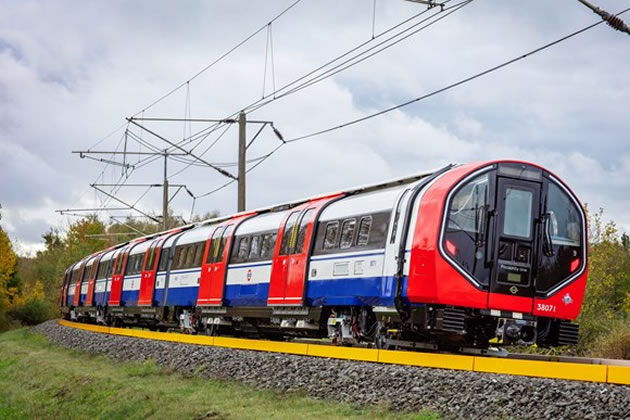
The new trains are 'the most complex ever' to be introduced on the underground. Picture: TfL
June 20, 2025
The timetable for the introduction of the new fleet of Piccadilly line trains has been delayed.
Transport for London (TfL) , having earlier said they would start to enter service at some point this year, has announced that they will only start operation in the second half of 2026.
The first train arrived in London from Vienna last year having undergone testing by Sieman’s in Germany and they have been undergoing further tests in the UK including overnight runs on London Underground tracks.
TfL says that this is the most complex train that has ever been introduced onto the Tube network and described the upgrade programme as ‘ambitious’. It added that new stock “ involves engineering challenges in designing, building and introducing these new trains onto one of the deepest and longest lines on TfL’s network, while ensuring they are fully integrated with London Underground infrastructure.”
Since the first train was delivered to London, TfL’s engineers have been assessing the train on site and this has allowed them understand the challenges for getting these new trains ready but this process has identified the process is more complex than expected. As a result, the start of a programme of testing the interactions with the infrastructure and systems has had to be rescheduled. Siemens Mobility and TfL have been working together to address these issues, which will allow testing to start in the summer.
Once testing starts, enough time is needed to fully test how the new trains will work on the oldest infrastructure on the Tube. Given the complexity of introducing this novel train into a railway that is more than one hundred years old and that is shared with other trains at some locations, it is expected that there will need to be further time to address any issues identified.
Under the original timetable the 94 train fleet was due to be fully operational by 2027, completely replacing the existing 1973 stock. This process appears likely to be delayed until at least 2028. Full deployment would allow frequency to increase from 24 to 27 trains per hour leading to a total capacity boost of 23%. However, train frequency will remain limited while the older stock continues to run.
These new trains offer ten per cent more capacity, walk-through air-conditioned carriages, wider double doorways for easier boarding, real-time digital displays and on-board CCTV for added security. The trains are lighter than existing designs, which, according to TfL, means they are more energy efficient and provide a smoother ride for customers, consuming 20 per cent less energy.
The train is the first Deep Tube train to have air conditioning; a feature that can only be achieved because of the novel space-saving design techniques that allow the air conditioning to be placed under the train.
Stuart Harvey, TfL's Chief Capital Officer, said, “We’re proud and excited that these innovative new trains on the Piccadilly line will have a transformative effect for London. This hugely complex project will boost capacity and make journeys more accessible and more comfortable for millions of people. This is an ambitious project with new 21st century trains providing engineering challenges in both building and introduction into service on a 20th century railway and it is critical that we ensure that safety comes first and that the trains are in top condition when they begin to service London.
“It will obviously be disappointing for customers that they will have to wait a bit longer for the new trains, and I regret that. But I would like to assure Londoners and visitors to our city that we are working extremely closely with Siemens to ensure that the new trains can be introduced as soon as possible in the second half of next year.”
Sambit Banerjee, Joint CEO at Siemens Mobility, said, “We’re working really hard with TfL to deliver the new Piccadilly line trains that are going to transform travel for people in London. Any project like this is complicated – we're bringing state-of-the-art, air-conditioned, walk-through trains into tunnels that were built 120 years ago.
“We’re sorry we can’t have our innovative trains running for passengers even sooner but, once they're in service, the technology on these new trains will bring smoother, greener and more comfortable journeys for Londoners for the next 30 or more years.”
The recent funding settlement from the government enabled TfL to complete the purchase of the new trains and provided funding for the completion of the Four Lines Modernisation project which should see local signalling upgraded on the District line. It remains unclear whether or not funding will be provided for the Piccadilly line signalling which would allow the new trains to contribute to an even larger boost to capacity on the line.
Like Reading Articles Like This? Help Us Produce More This site remains committed to providing local community news and public interest journalism. Articles such as the one above are integral to what we do. We aim to feature as much as possible on local societies, charities based in the area, fundraising efforts by residents, community-based initiatives and even helping people find missing pets. We've always done that and won't be changing, in fact we'd like to do more. However, the readership that these stories generates is often below that needed to cover the cost of producing them. Our financial resources are limited and the local media environment is intensely competitive so there is a constraint on what we can do. We are therefore asking our readers to consider offering financial support to these efforts. Any money given will help support community and public interest news and the expansion of our coverage in this area. A suggested monthly payment is £8 but we would be grateful for any amount for instance if you think this site offers the equivalent value of a subscription to a daily printed newspaper you may wish to consider £20 per month. If neither of these amounts is suitable for you then contact info@neighbournet.com and we can set up an alternative. All payments are made through a secure web site. One-off donations are also appreciated. Choose The Amount You Wish To Contribute. If you do support us in this way we'd be interested to hear what kind of articles you would like to see more of on the site – send your suggestions to the editor. For businesses we offer the chance to be a corporate sponsor of community content on the site. For £30 plus VAT per month you will be the designated sponsor of at least one article a month with your logo appearing if supplied. If there is a specific community group or initiative you'd like to support we can make sure your sponsorship is featured on related content for a one off payment of £50 plus VAT. All payments are made through a secure web site. |