Charlie Degale Wants to Get Black Men Talking About Cancer
Southfields resident turned his own health crisis into a new mission
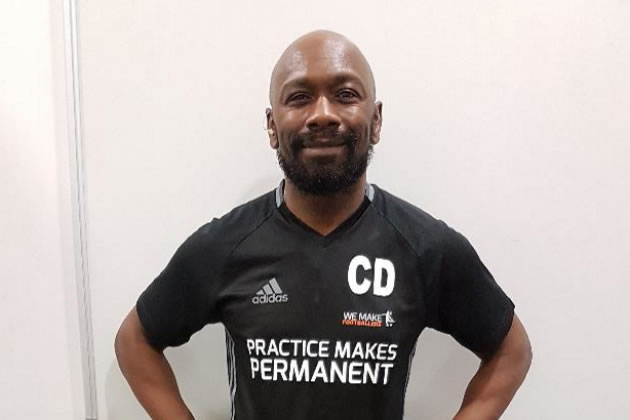 58-year-old Charlie Degale
July 28, 2023
A 58-year-old man from Southfields is on a mission to encourage his fellow Black men to open up and start talking about the subject of cancer.
Charlie Degale was diagnosed with germ cell tumours in 2016 and found himself faced with a wider community that struggles to talk about the disease. This prompted him to campaign to break down barriers and get people like him to be more open about what they are going through.
As Macmillan Cancer Support unveils worrying data about the human cost of this silence – 250,000 UK men with cancer are struggling with fear, depression or worry – Charlie has turned his health crisis into a renewed sense of purpose.
A vocal advocate for dispelling cancer taboos within the Black community, Charlie’s been a key contributor to the ‘Black Men Rising’ podcast, which aims to encourage more conversations around cancer and to motivate men to seek medical help earlier.
Charlie’s own shock diagnosis couldn’t have come at a worst time – within a month of launching his dream football coaching business, he was hit with the news that he the disease.
He said, “I’ll never forget when they called me at work and said that they needed to see me urgently. I went into St George’s and spoke to the oncologist there, where she confirmed that it was spreading. That’s when the alarm bells really started for me. It was in the lungs and they’d found a massive tumour behind the breastbone.”
However, having grown up in a community where it was unusual for people to speak about their feelings, he tried to deal with his diagnosis by himself, “Things that you thought would never affect you, especially as a man. Like a typical guy, I just got on with things.” Charlie explains how he kept a journal to record his experiences and feelings rather than opening up.
He added, “At the time I was going through treatment, I was the only Black man on my ward. A big turning point for me was when a young Asian man came in for treatment who had just been diagnosed with cancer and he was absolutely terrified – you could see the fear in his eyes.
“I spoke to him and it seemed to put him at ease, which made me realise what a difference talking about your own cancer experience can make to other people, especially people who may come from cultures and backgrounds where it might not be spoken about as openly.”
New analysis from Macmillan Cancer Support has revealed that more than one in three Black men say they don’t like to share their real feelings. And with one in four not feeling comfortable talking to others about things that worry them , the vital work of Charlie and other vocal voices is seemingly more needed than ever.
Charlie says, “It is frustrating because early detection is so vital. On the Black Men Rising podcast, there was a story of a guy who got prostate cancer and did nothing about it. Unfortunately, he passed away because of the taboo of going to the doctors, that attitude of ‘what are they going to do about it.’ It was a very blasé attitude. Had he done something about it, he may still be with us today.”
“Judging by what I’ve heard from our work on Black Men Rising, (this attitude) exists on a grand scale. Which is why it is important to get the message out there. Almost every guy that I spoke to on that podcast was affected by prostate cancer, the biggest killer amongst Black males. With any sign of discomfort in that area, you need to get it checked out no matter what. Particularly as there is no national screening programme for prostate cancer in the UK. It’s down to us.”
Happily, Charlie has been in remission since 2017, but he still must undertake twice-yearly check-ups. He also still wants to use his voice to inspire others.
As part of its ‘Find The Words’ campaign, Macmillan Cancer Support has just released a series of moving portraits, shot by award-winning photographer Ray Burmiston. The campaign features male celebrities and men affected by cancer to encourage more men to open up about their experiences and reach out for support.
The powerful photo series brings together Olympic diver and television personality Tom Daley, comedian, singer and actor Bill Bailey, First Dates star Merlin Griffiths, DJ and presenter Trevor Nelson, singer songwriter Jay McGuinness, actor Colin McFarlane and British journalist Nick Robinson. The celebrities were photographed alongside inspiring storytellers Luke Madalura (LJ), Nick Summerfield, Jeremy Langmead, Rian Harvey, Conor McNish-Lane and Brian Quavar who have all personally been affected by cancer. The celebrities and storytellers have joined forces with Macmillan to break down barriers many men can face when it comes to talking, highlighting the importance of leaning on friends, family or Macmillan for support.

A montage of the photos of celebrities taken by Ray Burmiston
Trevor Nelson, has friends and family who have been through cancer, including his mum who had bowel cancer. Trevor talks about the taboos around cancer and the importance of talking: “I was in complete shock when my mum was diagnosed, it was obviously very scary, but my family are very matter of fact – we tried to get on with it and deal with it.
“The biggest problem is when people simply go quiet about cancer and we could be losing them to it. I do know a few people who have had cancer and never told me. I’ve always wondered why they don’t want to tell you, it’s so important to talk.
“A colleague of mine, Adele Roberts, is an example of someone who has gone all out to drive the message home to people. She’s even given her stoma a name - ‘Audrey’. My mum’s got one. I imagine most people with a stoma don’t talk about it at all.
“What Adele’s done is incredible. I bumped into someone randomly the other day, who said, ‘do you know Adele? Can you tell her she saved my mate’s life.’ I called her and she got emotional about it – this just shows the power that talking has.”
Chris Bolton, Service Knowledge Specialist on the Support Line at Macmillan Cancer Support, said, “We continue to see fewer calls from men contacting the Macmillan Support Line, but we want men to know, that there is support available. We find many men hold back from talking, to protect the people around them, to not be a burden on their family, or a bother to their friends but it doesn’t have to be this way.
“Our specially trained nurses and advisers are at the end of the phone seven days a week (8am-8pm) for people living or affected by cancer, whatever they need to ask. There’s also our Online Community where men can chat anonymously if that feels more comfortable.”
Whatever questions people need to ask whether that be about work, money, life…Macmillan is at the end of the phone and online to provide support. Call 0808 808 00 00 or visit macmillan.org.uk/findthewords and ask anything.
You can find the Black Man Rising podcast via Apple and other podcast platforms.
Like Reading Articles Like This? Help Us Produce More This site remains committed to providing local community news and public interest journalism. Articles such as the one above are integral to what we do. We aim to feature as much as possible on local societies, charities based in the area, fundraising efforts by residents, community-based initiatives and even helping people find missing pets. We’ve always done that and won’t be changing, in fact we’d like to do more. However, the readership that these stories generates is often below that needed to cover the cost of producing them. Our financial resources are limited and the local media environment is intensely competitive so there is a constraint on what we can do. We are therefore asking our readers to consider offering financial support to these efforts. Any money given will help support community and public interest news and the expansion of our coverage in this area. A suggested monthly payment is £8 but we would be grateful for any amount for instance if you think this site offers the equivalent value of a subscription to a daily printed newspaper you may wish to consider £20 per month. If neither of these amounts is suitable for you then contact info@neighbournet.com and we can set up an alternative. All payments are made through a secure web site. One-off donations are also appreciated. Choose The Amount You Wish To Contribute. If you do support us in this way we’d be interested to hear what kind of articles you would like to see more of on the site – send your suggestions to the editor. For businesses we offer the chance to be a corporate sponsor of community content on the site. For £30 plus VAT per month you will be the designated sponsor of at least one article a month with your logo appearing if supplied. If there is a specific community group or initiative you’d like to support we can make sure your sponsorship is featured on related content for a one off payment of £50 plus VAT. All payments are made through a secure web site. |
