Hounslow Takes Its Golden Mile Masterplan to Cannes
Seeking investment for its vision to deliver 14,000 homes and 25,000 jobs
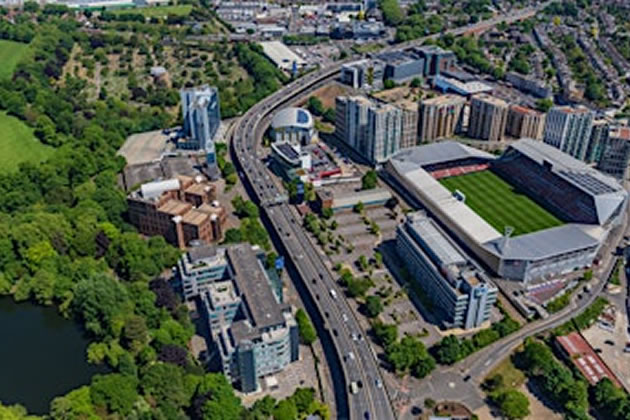
An aerial view of part of the Golden Mile. Picture: Hounslow Council
March 10, 2026
This week in Cannes, a delegation from Hounslow Council is competing for global attention alongside the world’s largest sovereign wealth funds, institutional landlords and listed developers. The borough’s team will be pitching its masterplan for the Golden Mile.
The four-kilometre stretch of the Great West Road between Chiswick Business Park and Heathrow has long been one of west London’s most important economic arteries. It celebrated its centenary in 2025, its Art Deco factories and broadcasting campuses making it a corridor of genuine industrial heritage. Now, the council is seeking to transform it into what it calls a “Creative-Tech Innovation District” — promising 14,000 homes, 25,000 jobs and a gross development value of £7.5 billion over a fifteen-year programme.
The Investment Framework, formally approved by Cabinet in January 2026, was launched in February at Brentford FC’s Gtech Community Stadium in front of the developers and anchor businesses who are already “in the game”, as the council put it.
Several substantial schemes are already in motion, with planning consent granted last week for the former GlaxoSmithKline headquarters at 980 Great West Road, where Hadley Property Group proposes to build around 2,300 housing units and 320,000 sq ft of commercial space.
The Areli Group is advancing “Brentford Works”, a mixed-use scheme on the former Sega European headquarters site with 850 flats and maker workspace clustered around Golden Mile Square. A “Gillette Studios” project aims to repurpose a Grade II listed Art Deco complex for film and virtual production.
The council is also using the conference to promote Future Feltham, its plans to transform a former Ministry of Defence site into what it describes as London’s first “truly green, intergenerational neighbourhood”, and to highlight energy infrastructure ambitions including a borough-wide district heat network backed by £10.55 million from the Green Heat Network Fund.
The investment sought is primarily private: developers willing to bring land forward for residential and mixed-use development, and anchor occupiers in the creative and technology sectors to fill workspace. The council’s own direct commitment is comparatively modest — £1.15 million seeded into the Golden Mile programme and early priority projects including a proposed Innovation Hub and streetscape improvements along the A4.
The most significant — and most uncertain — element of the whole vision is a railway line that does not yet exist. Speaker after speaker at the February launch event stressed that the success of the Golden Mile masterplan depends substantially on the West London Orbital, a proposed London Overground extension that would run approximately 18.5 kilometres between Hendon and Hounslow via Old Oak Common, Brentford and a series of new stations on underused freight lines.
TfL, Hounslow and three other west London boroughs agreed this month to commit £6.65 million to progress the scheme to its next design phase, with a public consultation planned for summer 2026 and a decision on whether to apply for statutory powers expected in late 2027. Supporters point out that the line repurposes existing freight infrastructure, keeping costs down relative to tunnelled alternatives, and that its benefit-cost ratio has been assessed by TfL as “medium to high”. If approvals go smoothly, services could begin in the 2030s.
But “could begin in the 2030s” is a long way from a shovel in the ground, and the £6.65 million now committed is design money, not construction money. The project is still estimated to cost around £700 million in total, and central government funding — which TfL acknowledges it still needs — has not been secured. The West London Orbital has been a priority scheme on TfL’s wish-list for years. London’s history is littered with orbital rail proposals that never reached fruition. Investors and developers weighing up whether to bring schemes forward along the Great West Road will be doing so against a transport improvement that remains, for now, a proposal.
Schemes that look coherent on a masterplan frequently fragment under the pressure of land assembly, viability, planning disputes and changing market conditions. The Golden Mile is not a single site under a single ownership. It is a 450-acre zone involving dozens of landowners, occupiers and development interests, each with their own timelines and risk appetites.
The market context at MIPIM this year is also likely to be more cautious than it was in the boom years. Build costs remain elevated relative to pre-2020 levels, debt is more expensive, and investors attending Cannes in 2026 are described by industry analysts as “capital present, yet selective”. Regeneration strategies carry weight only when supported by demonstrable market activity and realistic pricing.
There is also a question about the “Creative-Tech Innovation District” framing. The Golden Mile does have genuine creative sector roots: the corridor is home to Sky, Warner Bros. Discovery, Brompton Technology and JCDecaux, and the council notes that 37% of the UK’s broadcast media jobs are located here. Whether it constitutes a magnet for the start-ups, scale-ups and technology companies needed to justify the innovation district label — in competition with White City, Paddington and Old Oak — is a more open question.
The Golden Mile London governance structure, including a Business and Developers Forum, is a more sophisticated coordination mechanism than many comparable regeneration zones have attempted.
Hounslow’s Golden Mile programme is a serious and reasonably well-founded regeneration vision, not mere boosterism. The underlying assets are strong, the lead developers are credible, and the council has done more than most to create a coherent long-term framework. But the headline numbers — 28,800 borough-wide homes, 18,000 jobs, £7.5 billion — are projections over a fifteen-year horizon, and the programme’s full ambition depends on transport infrastructure whose funding is not yet in place and whose timeline stretches into the 2030s.
Like Reading Articles Like This? Help Us Produce More This site remains committed to providing local community news and public interest journalism. Articles such as the one above are integral to what we do. We aim to feature as much as possible on local societies, charities based in the area, fundraising efforts by residents, community-based initiatives and even helping people find missing pets. We’ve always done that and won’t be changing, in fact we’d like to do more. However, the readership that these stories generates is often below that needed to cover the cost of producing them. Our financial resources are limited and the local media environment is intensely competitive so there is a constraint on what we can do. We are therefore asking our readers to consider offering financial support to these efforts. Any money given will help support community and public interest news and the expansion of our coverage in this area. A suggested monthly payment is £8 but we would be grateful for any amount for instance if you think this site offers the equivalent value of a subscription to a daily printed newspaper you may wish to consider £20 per month. If neither of these amounts is suitable for you then contact info@neighbournet.com and we can set up an alternative. All payments are made through a secure web site. One-off donations are also appreciated. Choose The Amount You Wish To Contribute. If you do support us in this way we’d be interested to hear what kind of articles you would like to see more of on the site – send your suggestions to the editor. For businesses we offer the chance to be a corporate sponsor of community content on the site. For £30 plus VAT per month you will be the designated sponsor of at least one article a month with your logo appearing if supplied. If there is a specific community group or initiative you’d like to support we can make sure your sponsorship is featured on related content for a one off payment of £50 plus VAT. All payments are made through a secure web site. |