Labour Takes Local London Assembly Seat for First Time
James Small-Edwards ousts incumbent Tony Devenish
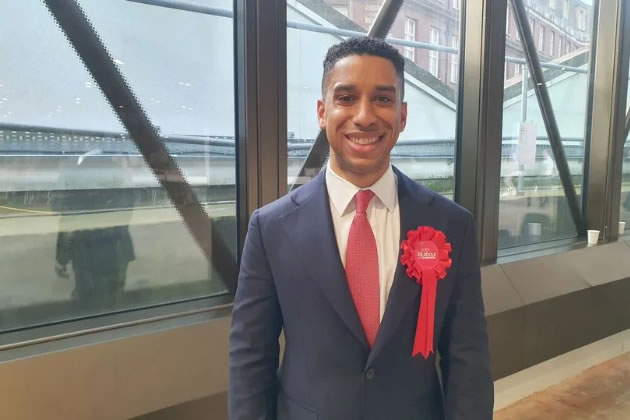
Winning Labour candidate James Small-Edwards
Last Thursday (2 May) election saw Labour take the West Central London Assembly seat for the first ever time with James Small-Edwards winning by just over 4,000 votes. The constituency, which covers the boroughs Hammersmith and Fulham, Kensington and Chelsea and Westminster, also backed Labour in the mayoral vote.
Conservative Tony Devenish, who has held the seat since 2016, said it has been a ‘huge honour’ to represent the area, and that his priority “will always be the people in this part of London”.
Mr Small-Edwards, who won with 46,831 to second-place Mr Devenish’s 42,578, said the result was ‘humbling’ on a day when his party picked up both the local constituency and Mayoral votes.
Cllr Stephen Cowan, Labour Leader of Hammersmith and Fulham Council, described the result as a 'huge endorsement for Keir Starmer’s Labour Party'. He continued, "We’re winning significantly in areas that we’ve not won before, and while there’s no complacency, it bodes well for Chelsea and Fulham, the City of Westminster, and Kensington in the General Election.”
Local turnout was down when compared with the 2021 elections, from 39 per cent to 34.94 per cent. Mr Devenish won by just over 2,000 votes four years’ ago, after being run close by Labour’s Rita Begum.
Sadiq Khan was ten percentage points clear in the Mayoral vote in the West Central constituency with many voters who had backed the Lib Dem or Green candidate for the Assembly, switching their vote to Labour in the Mayoral contest.
Mr Small-Edwards, who is the son of singer Heather Small and rugby coach Shaun Edwards, said continuing support for the cost-of-living crisis will be one of his key aims on the London Assembly, alongside more affordable and social housing and action to combat climate change.
2024 London Assembly election: West Central |
||||||
Party |
Candidate |
Constituency |
List |
|||
Votes |
% |
±% |
Votes |
% |
||
Labour |
James Small-Edwards |
46,831 |
37.7 |
+0.4 |
45,102 |
36.2 |
Conservative |
Tony Devenish |
42,578 |
34.2 |
-4.6 |
39,049 |
31.3 |
Liberal Democrats |
Christophe Noblet |
14,505 |
11.7 |
+2.2 |
11,223 |
9.0 |
Green |
Rajiv Rahul Sinha |
12,427 |
10.0 |
-1.6 |
11,717 |
9.4 |
Reform UK |
Nicola Pateman |
8,040 |
6.5 |
+5.1 |
5,856 |
4.7 |
Rejoin EU |
4,533 |
3.6 |
||||
Animal Welfare |
1,967 |
1.6 |
||||
Britain First |
1,147 |
0.9 |
||||
CPA |
1,014 |
0.8 |
||||
SDP |
986 |
0.8 |
||||
Independent |
Laurence Fox |
838 |
0.7 |
|||
Communist |
528 |
0.4 |
||||
Independent |
Farah London |
312 |
0.3 |
|||
Heritage |
221 |
0.2 |
||||
Independent |
Gabe Romualdo |
61 |
0.1 |
|||
Majority |
4,253 |
|||||
Valid Votes |
124,381 |
124,554 |
||||
Invalid Votes |
1,143 |
983 |
||||
Turnout |
125,524 |
34.94 |
125,537 |
34.95 |
||
Labour gain from Conservative |
||||||
Despite its gains, Labour does still does not have a majority on the London Assembly now holding 11 out of the 25 seats. The party will be dependent on support for the Greens who have three representatives and the Liberal Democrats with two. The Conservatives now have eight members in the assembly.
There was some speculation on social media on Friday evening that the Mayoral election could end up being closer than expected. Figures released on Friday showed that turnout was down in all seven London Assembly constituencies in which Sadiq Khan polled more first preference votes than his Tory rival Shaun Bailey in 2021. Turnout had meanwhile risen in some of the constituencies which had returned Conservative candidate. With not a single vote counted at this point, these predictions of a tight contest proved ill-founded with Sadiq Khan going on to win a third term with an increased majority receiving 43.8 per cent of the votes (1,088,225) to Susan Hall’s 32.7 per cent (811,518).
Ms Hall congratulated the Mayor on his victory, before saying he must make tackling crime his top priority adding, “He owes it to the families of those thousand people who have lost [their] lives to knife crime, under his mayoralty.
“I will continue to hold Sadiq to account, to stand up for hard-working families, for motorists and for women.”
The best ever result for a winning candidate in terms of vote-share was achieved by Mr Khan in 2016, when he secured his first term as mayor with 44.2 per cent of ‘first preference’ votes, under the old ‘supplementary vote’ system.
For this year’s City Hall election and others going forward, the voting system has been changed to ‘first past the post’, meaning that voters are no longer able to choose a first and second preference for mayor. The winning candidate now simply had to receive more votes than any other.
The lowest win, by vote-share, was that of Labour’s Ken Livingstone when he won re-election in 2004, with 37 per cent of first preferences. This was down from the 39 per cent he received when running as an independent in 2000.
In that earlier contest – the capital’s first mayoral election – Mr Livingstone achieved the largest margin of victory by a London mayor over their nearest opponent, defeating Tory candidate Steven Norris by 11.9 percentage points.
By contrast, the narrowest winning margin was held by Tory mayor Boris Johnson when he secured a second term in 2012 with just 3.7 percentage points over Mr Livingstone.
Since the mayoralty’s creation in 2000, overall turnouts for City Hall elections have averaged at about 40 per cent.
Historically, the highest turnouts in London mayoral contests have been in the ‘change’ elections of 2008 and 2016 – when Tory mayor Boris Johnson and Labour mayor Sadiq Khan each seized their first victories, respectively. But even in those contests, fewer than half of eligible Londoners actually voted, as only 45 per cent turned out in each.
At the other end of the scale, the lowest turnout recorded was in the mayoralty’s first election in 2000, back when Londoners were unused to the idea of having a directly-elected mayor. Just over a third of those eligible – 34 per cent – cast their ballots.
Written with contributions from the Local Democracy Reporting Service
Like Reading Articles Like This? Help Us Produce More This site remains committed to providing local community news and public interest journalism. Articles such as the one above are integral to what we do. We aim to feature as much as possible on local societies, charities based in the area, fundraising efforts by residents, community-based initiatives and even helping people find missing pets. We’ve always done that and won’t be changing, in fact we’d like to do more. However, the readership that these stories generates is often below that needed to cover the cost of producing them. Our financial resources are limited and the local media environment is intensely competitive so there is a constraint on what we can do. We are therefore asking our readers to consider offering financial support to these efforts. Any money given will help support community and public interest news and the expansion of our coverage in this area. A suggested monthly payment is £8 but we would be grateful for any amount for instance if you think this site offers the equivalent value of a subscription to a daily printed newspaper you may wish to consider £20 per month. If neither of these amounts is suitable for you then contact info@neighbournet.com and we can set up an alternative. All payments are made through a secure web site. One-off donations are also appreciated. Choose The Amount You Wish To Contribute. If you do support us in this way we’d be interested to hear what kind of articles you would like to see more of on the site – send your suggestions to the editor. For businesses we offer the chance to be a corporate sponsor of community content on the site. For £30 plus VAT per month you will be the designated sponsor of at least one article a month with your logo appearing if supplied. If there is a specific community group or initiative you’d like to support we can make sure your sponsorship is featured on related content for a one off payment of £50 plus VAT. All payments are made through a secure web site. |
May 6, 2024